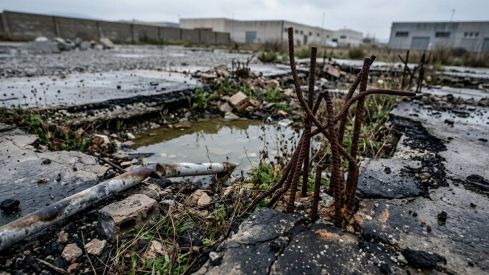
The Tortosa City Council has put out to tender the drafting of the executive project and the site management of the new slaughterhouse, a contract with an initial budget of 125,019.57 euros plus VAT to replace a facility that was destroyed by a fire in the Baix Ebre industrial estate.
The reconstruction comes after the service has been operating outside the municipality since the incident. Before the fire, the facility served the entire Terres de l'Ebre region with an annual production of one million kilos, and now the activity continues in Borriana, in the province of Castelló, with additional costs assumed by the council.
The new project foresees a work of 2.8 million after complete demolition
The facility suffered serious structural damage due to the fire, a situation that forced its complete demolition. The approximate cost to rebuild the slaughterhouse amounts to 2.8 million euros plus VAT.
Escorxador de Tortosa is a mixed company in which the City Council controls 89% of the ownership, while the remaining 11% belongs to around fifty meat industry professionals and butchers.
Sònia Rupérez, secretary of the company and councilwoman, defended the role the facility played within the sector in southern Catalonia.
"It was a local, zero-kilometer slaughterhouse; the largest among the small ones and the only pig slaughterhouse in the demarcation of Tarragona" - Sònia Rupérez, secretary of the company and councilwoman
In addition to Tortosa, the service had a regional reach and served the entire Terres de l'Ebre. The tender now open must serve to define the technical project and assume the management of a work that has not yet begun.
Activity continues in Borriana and the council laid off three employees on May 11
After the fire, the company initially considered moving the activity to the Morella slaughterhouse, but that option was discarded due to scheduling and veterinarian availability issues. Finally, the service was transferred to Borriana, where it is currently located.
Since then, the Tortosa City Council has assumed the additional costs of operating outside the municipality. Rupérez assured that reconstruction has been the priority from the outset and that work has continued with users to try to make the return of the service viable.
The councilwoman also explained that the relationship with private partners has been maintained during the past months with constant information about the situation of the slaughterhouse and the steps taken by the mixed company and the city council.
Last May 11, the board of directors agreed to dismiss and compensate the three workers who remained under a redundancy plan since the closure caused by the fire.
Rupérez regretted that decision and pointed out that the board did not want to adopt it, but considered it the only possible way out to avoid further harming the staff. The councilwoman added that the City Council maintains its commitment to rebuilding the facility, considering it necessary for Tortosa and the Terres de l'Ebre.
The mixed company that operates the service maintains a capital composition with 89% municipal participation and 11% in the hands of about fifty meat industrialists and butchers.