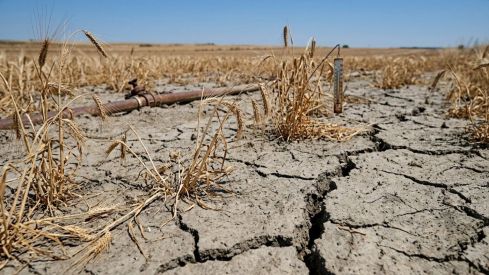
Climate change will expand the area suitable for crops such as almond, olive, or orange trees in Catalonia, but at the same time will increase the need for water to a point that may reduce their profitability in many areas. A report prepared by experts for the consultancy Espigall estimates an increase of 16% in water needs for crops between 2031 and 2050, more than double the previous forecast of 7%.
The main contradiction appears in the water. The stored reserves exceed 85% of their capacity today, but snow reserves are at drought thresholds after a record winter. In that scenario, the document warns of structural changes in agricultural production and crop distribution, with a special impact on regions of Lleida and the Pyrenees.
The almond tree will gain 19.4% of land, but irrigation will limit its exploitation
The study predicts that the almond tree could be cultivated on 19.4% more land, the orange tree on 12.2%, and the olive tree on 7.2%. This potential expansion does not imply automatic intensive implementation, because the lack of irrigation infrastructure appears as one of the main brakes.
In Lleida, the future aptitude map is clearly shifting. The almond tree will be viable in most of Noguera and Solsonès, the olive tree will be able to extend through Alt Urgell and Pallars, and the orange tree will reach Les Garrigues.
However, the same report points out that 45% of the land dedicated today to barley will require irrigation. In the intensive cultivation of this cereal, that need rises to 75% of the surface where it can grow.
There the economic problem appears. The need to irrigate will reduce productivity in many areas due to the small profit margin, since in some cases it does not pay to assume that cost, as already happens in eastern Lleida.
The plain and the Pyrenees will face more heat and less rain between 2031 and 2050
The climate forecasts handled by the document point to an average temperature increase of 1.9 degrees in summer and 1.7 degrees in autumn in the plains. In the Pyrenees, the predicted warming also reaches 1.9 degrees in summer and 1.8 degrees in autumn.
At the same time, rain will decrease almost all year. In winter, the expected decrease is 1.1% in the plain and 1.8% in the Pyrenees, while in the rest of the seasons the reduction will range between 8.4% and 11.5%.
That change will also push climate regimes towards higher altitudes. The report indicates that the subtropical thermal regime will grow substantially and that the semi-arid Mediterranean humidity regime will be the most common in the future scenario, displacing humid regimes towards higher altitudes.
Lleida registered 167 deaths from heat between 2021 and 2025
The impact is not limited to the field. Data from the Carlos III Health Institute show that between 2021 and 2025, 167 people died from heat in Lleida, with an annual average of 33 deaths.
The comparison with the previous period shows an increase. Between 2016 and 2020, the annual average was 25 heat-related deaths in the demarcation.
The report for Espigall sets for the horizon 2031-2050 an increase in water needs of 16%, when the previous forecast placed that increase at 7%.