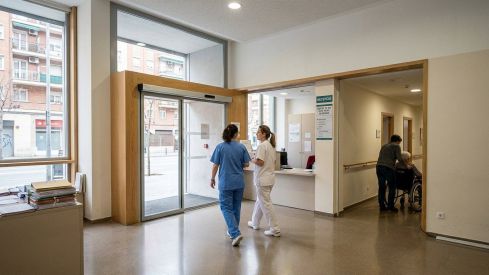
The Generalitat will stop claiming debts for undue collections of dependency benefits in cases of deceased persons and also in situations derived from changes in the personal situation when the error is attributable to the administration itself. The announcement was made this Monday by president Salvador Illa during a visit to the residence and day center of Gent Gran de Gràcia, in Barcelona.
The decision comes after cases such as that of Lluís Boada, a 23-year-old resident of Valls with a 78% disability, whom last March the Departament de Drets Socials i Inclusió claimed 4,251.30 euros from for alleged undue payments of an economic benefit linked to the Ley de Dependencia.
A change after thousands of claims
Illa framed the measure within the Pla Cura, recently announced to streamline the processing of aid destined for the care of people with dependency. The president assured that the Govern wants to correct a practice that had been occurring for years.
"We will remedy a situation that should not have occurred. Claiming money from a person who has died seems like a bad taste joke, but it had been happening for decades" - Salvador Illa, president of the Generalitat
During his intervention, Illa specified that in 2025 the administration came to claim 10,665 debts for undue collections of dependency benefits. He also recalled that, with the regulations in force until now, those amounts were considered undue and therefore were demanded even from the relatives of already deceased persons.
"According to the existing regulations, they were considered undue and therefore had to be claimed from the relatives" - Salvador Illa, president of the Generalitat
The case of Lluís Boada in Tarragona
In Boada's case, the amount claimed corresponded to a difference between the benefit she should have received and the one she continued collecting for more than two years. The allowance would have gone from 387 to 228 euros monthly, but the previous amount continued to be paid to her.
Illa advanced that the condonation will also be applied in cases like this, linked to modifications in the situation of the beneficiary person. Furthermore, the Govern foresees changing the design of the benefits to avoid that undue payments occur again. If even so they were repeated and were a consequence of an administrative error, they will not be claimed either.
Boada was satisfied with the announced turn and grateful that action had been taken. He explained that the only thing he had done was claim his rights on more than one occasion. His diagnosis includes laminopathy, severe muscular dystrophy, loss of cephalic control, respiratory insufficiency, and cardiac anomalies.
Apologies of the Govern and review of the system
The Minister of the Presidency, Albert Dalmau, publicly conveyed an apology and thanked Boada for having reported a situation that can now be corrected. The message from the Govern points to a fundamental rectification in the management of these aids and in the relationship with the affected people.
It is not the first time that Boada manages for a claim to result in an institutional response. Two years ago, he already requested to have an assistant and adapted transport to travel from his home in Valls to the Universitat Rovira i Virgili, where he studies Psychology. Finally, the Generalitat assigned him the necessary support to attend class.
"When people with disabilities contact the administration, we do so like any other person, but with the added disadvantage of not having as many tools" - Lluís Boada
The young man from Tarragona now hopes that the announced change goes beyond his case and serves to make the administration more accessible to people with more difficulties. That is the challenge that the Govern now places on the table, with the review of a system that for years generated economic claims to families and beneficiaries due to errors that, in part, were born within the administration itself.