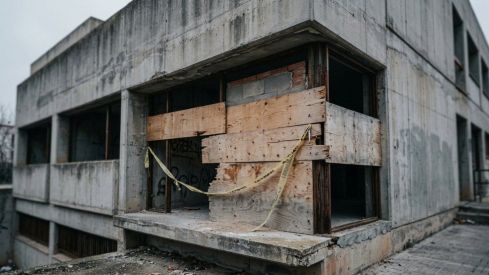
The Generalitat has boarded up the entrances to the public elderly residence ICASS in Reus, on Passeig Mata, while it prepares to demolish the building to construct a new one. The facility has been closed since July 2024 due to structural problems, and the Government frames the measure within the procedures prior to the replacement of the property.
The action comes with a double tension on the table. The building was closed due to structural deficiencies, but at the same time, the Col·legi d'Arquitectes de Catalunya maintains that it is salvageable and opposes the demolition of one of the few examples of brutalist architecture in southern Catalonia.
The Generalitat Boards Up the Residence to Prevent Squatting and Protect the Demolition Schedule
Sources from the Department of Social Rights explain that boarding up aims to prevent illegal occupations that could slow down the process. The department adds that an entry into the property would pose a risk to those who entered, precisely because of the condition that forced the residence to close last July.
"If they were to occur, they would pose a risk to potential occupants since the building was closed due to structural deficiencies and, furthermore, they would delay the demolition and construction of the new residence, a much-needed facility for the city" - Sources from the Department of Social Rights, Generalitat de Catalunya
The Government has opted to demolish the facility after an agreement signed with the State and the Ajuntament de Reus. Within that schedule, the tender for both the demolition and the construction of the future center is planned for 2026.
In April, during a visit to Reus, the Minister of Social Rights, Mònica Martínez Bravo, announced that the works for the new facility will begin in 2027. The minister also argued that the new residences are designed with current standards of quality, sustainability, and small living units.
The COAC Opposes Demolition and Argues the Building Can Still Be Rehabilitated
The clearest opposition to the operation has been expressed by the Col·legi d'Arquitectes de Catalunya, which claims the value of the property on Passeig Mata as one of the few brutalist buildings in southern Catalonia. The entity questions whether the disappearance of the property is the only possible solution.
Jordi Romera, president of the Tarragona Demarcation of the COAC, and Josep Maria Boronat, president of AADIPA, maintain that the building is perfectly recoverable. Both also warn of the environmental impact that demolishing nearly 10,000 square meters of concrete would entail.
The architects describe the decision as an outrage to contemporary heritage and propose a rehabilitation that preserves part of the original structure. Also weighing in on the discussion about the complex's future is the transformation of Paseo Mata, one of the urban environments where the residence is located.
In response to this criticism, the Department of Social Rights states that the decision was made by consensus and after evaluating alternatives and constraints. The department maintains that rehabilitating and adapting the current building would cost significantly more than demolishing it and building a new residence.
Mònica Martínez Bravo stated during her April visit to Reus that new residences for the elderly are designed with small living units and with quality and sustainability standards that, in her words, very positively improve user well-being.