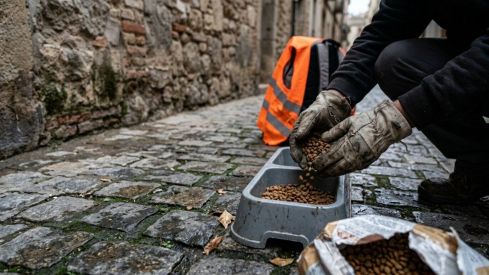
The Tarragona City Council will identify authorized feline colony managers with an official ID card and vest to accredit their work on the street and protect them from episodes of harassment and aggression. The measure affects a network that supports the care of 3,422 stray cats spread across 322 colonies in the municipality.
The decision comes in a context of strong municipal dependence on this volunteer work. The 2024 Animal Welfare Law assigns urban cat management to city councils, but the council admits it cannot undertake alone a task that currently falls to 270 volunteers, who also largely finance the food and care.
The council acknowledges that 270 volunteers support the care of 3,422 cats
Sandra Ramos, councilor for Animal Welfare of the Tarragona City Council, frames the new accreditation system within this structural dependence on the citizen network.
"Managing this volume of animals would be impossible without the free, altruistic, and sacrificial collaboration of volunteers" - Sandra Ramos, councilor for Animal Welfare, Tarragona City Council
Of the 270 people involved in colony management, 178 have already completed specific training and have a valid ID card. Another hundred are undergoing the training process, which the city council provides in civic centers and plans to offer online as well.
In addition to accrediting the feeders, the municipality reminds that interfering with their work is prohibited and can lead to sanctions. For conflicts with residents, the city council provides a municipal mediation service.
Municipal regulations also limit how the animals are fed. Only accredited individuals should provide dry food and then remove the containers, while leaving domestic food scraps is prohibited for health reasons.
In parallel, the council will distribute 7 tons of feed for the colonies, although the administration itself acknowledges that this amount does not cover annual needs. The city council also wants to expand the TNR (Trap-Neuter-Return) method to ethically control populations and train its officials on the legal obligations imposed by the law.
Organizations denounce sabotage and request protection in the most exposed colonies
The associations working on the ground describe a scenario of continuous wear and tear. They report acts of vandalism, fires in colonies, attacks on animals and poisonings, in addition to the lack of volunteers and shelters.
Gloria Herrera, from Rodogats Pere Pau, recounts some of these attacks suffered at feeding stations.
"They destroy the feeders, urinate in the water bowls, throw motor oil in them, or steal the food we buy with our money" - Gloria Herrera, Rodogats Pere Pau
For this reason, only some colonies will have official identification signs. The city council opts to keep those located in vulnerable areas anonymous to reduce the risk of theft or poisoning.
The management of these colonies is also now part of the municipal works planning. In La Tabacalera, where about a hundred animals live, the council has already held meetings to integrate their presence into the planned interventions.
Removing a colony does not eliminate the problem because the vacuum effect favors other cats occupying the same space. The role of volunteers is to act where the animals are already settled, control their health status, and carry out sterilizations, in addition to the ecological role they play in limiting rodent and insect pests.
Currently, 178 out of 270 volunteers have their cards in effect and around a hundred more are undergoing specific training to obtain municipal accreditation.