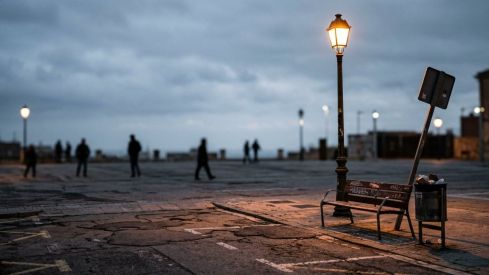
Immigration is already the second problem and citizen insecurity the third in Tarragona, according to the barometer of the Centre d'Estudis d'Opinió, while criminal offenses have fallen by 6.1% in the province in the last year.
The contrast between perception and data once again places Tarragona at the center of public debate. Records from the Ministry of the Interior also show a 5.1% drop in conventional crime and an 11% drop in cybercrime.
Crimes decrease by 6.1% while concern about insecurity grows
Between 2019 and 2025, crimes in Tarragona have increased by 14%, in parallel to a population increase of 90,000 people. In that same period, sexual crimes have risen by 75% and cybercrime by 78%.
Homicides and thefts remain stable in the province. Robberies with violence and intimidation and burglaries have also decreased.
Immigration and insecurity occupy the top two spots on the CEO barometer in Tarragona with maximums for the last decade.
Laura Arantegui, professor of the Law and Political Science studies at the UOC, maintained that the perception of insecurity does not align with official data. She added that in Barcelona and Catalonia, crimes are down 6% compared to 2024 and that those linked to repeat offending are also down 8%.
Arantegui and Setó attribute the gap between perception and figures to other factors
"I perfectly understand the perception of insecurity that does not align with the reality of the data. The number of crimes is decreasing in Barcelona and Catalonia, by 6% compared to 2024, and there is even an 8% decrease in those crimes linked to repeat offending. Robberies, thefts, and more common crime are decreasing… A homicide weighs more in public opinion than 100 thefts, but homicides also do not have an upward trend" - Laura Arantegui, professor of the Law and Political Science studies at the UOC
Ramon Setó, criminal lawyer and secretary of the governing board of the Official College of Lawyers of Tarragona, stated that the perception of insecurity is basic and that any violent act can feed it, even if there is no repetition.
"The perception of insecurity is very basic and it is important to always address it, but any violent act generates it for you, there is no need for there to have been a repetition" - Ramon Setó, criminal lawyer and secretary of the governing board of the Official College of Lawyers of Tarragona
David Garreta, psychologist, criminologist and president of the association Fòrum de la Criminologia based in Salou, linked that gap to media impact, overrepresentation on networks and political discourse. He also warned of the dark figure, which includes unreported crimes, such as hate crimes, of which he cited 90% that does not surface.
Sexual offenses have risen by 75% and cybercrime by 78% between 2019 and 2025 in Tarragona.
Garreta also pointed out that the visualization of space, circulation, the state of the pavement, or lighting influence the feeling of security in specific neighborhoods. He also cited the broken windows theory, which associates more urban decay with more crime.
Laura Arantegui added that drug trafficking-related crimes are increasing and that knife incidents also rise seasonally. In her opinion, those crime areas require more measures and perhaps some operational reinforcement.
Ramon Setó warned of generalizations and excessive alarmism, which he attributed to political groups and certain media and social networks.
The INE places the drop in the percentage of convicted foreigners out of the total in Tarragona between 2014 and 2024, from 25% to 3%, while the weight of foreigners in murder convictions has remained stable in the last decade.
David Garreta added that attributing the majority of crimes to a nationality oversimplifies the problem and gave as an example the Mas d'Enric prison, where foreigners can exceed 30% compared to the 12% they represent of the total population.