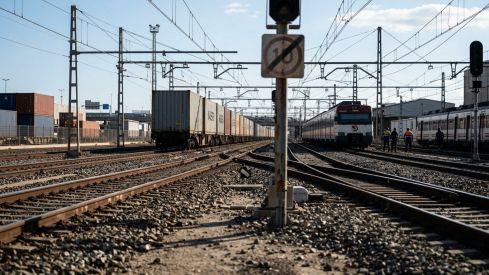
The railway section between Tarragona and Sant Vicenç de Calders will reach collapse with the entry into operation of the Mediterranean Corridor, planned for 2027, according to a study promoted by the Platform Mercaderies per l'Interior. The report places the line in a pre-collapse phase and warns that the increase in traffic will worsen a network that is already operating near its limit.
The paradox, according to the analysis, is that an infrastructure intended to strengthen rail freight transport may end up expelling cargo from the track if traffic is not reorganized. The study maintains that the priority of passenger trains over freight trains will further strain the system and may return some of these routes to trucks.
The line will go from 170 to 251 trains daily
In 2023, the current corridor registered 170 trains per day between passenger and freight services. That figure already represented 85% of the total capacity of the section between Tarragona and Sant Vicenç de Calders.
With the launch of the Mediterranean Corridor, the forecast rises to 251 trains per day. The report calculates that this volume would bring occupancy to 126% of the network's planned capacity at that point.
Efraín Larrea, the engineer author of the study, maintains that the infrastructure is already in a state of pre-collapse and saturation. In his opinion, giving priority to passenger traffic over freight will add more tension to a route that also channels a large part of the logistics activity in Camp de Tarragona.
In addition to the increase in frequencies, the pressure comes at a time when rail still has a reduced weight in freight movement. The company Mcrit calculates that this transport currently represents between 3% and 4% in Tarragona and could reach 10% in 2030 with the opening of the third track.
"When someone who used the train to export goods sees that the solution doesn't work for them and goes back to the truck, it will be difficult to convince them to return to the train" - Efraín Larrea, engineer in charge of preparing the study, Plataforma Mercaderies per l'Interior
The platform proposes a diversion via Vila-seca, Valls and Camp de Tarragona
The proposal from the Plataforma Mercaderies per l'Interior involves diverting some freight trains from the most congested section. The alternative outlines a route from the Vila-seca junction to Valls and then uses the high-speed line between Camp de Tarragona and Roda de Berà.
The report concludes that this option would be profitable and that the necessary investment would have a return in five years. The platform argues that this reorganization would allow freeing up capacity on the coastal section and reducing the risk of incidents when the new corridor scheme comes into operation.
Without this diversion, Larrea warns that train delays and cancellations will increase. The study also considers that, during periods of high saturation, some travelers may have to complete the journey by road.
The warning affects both passenger mobility and industrial activity. The analysis points out that companies may lose competitiveness or even leave Tarragona if they cannot receive raw materials or ship their goods by rail.
The figure that summarizes the risk appears in the central forecast of the study, which places the section between Tarragona and Sant Vicenç de Calders at 126% occupancy when the Mediterranean Corridor comes into operation in 2027.