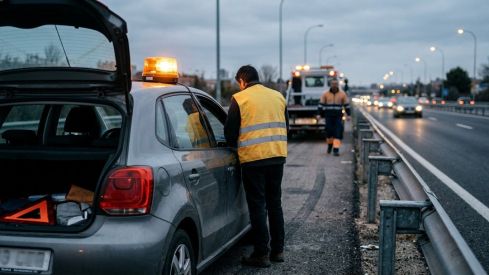
The entry into force of the regulation that mandates the use of connected V16 beacons has not yet managed to transform the habits of millions of Spanish drivers. Despite the fact that since January 1st it has been mandatory to use these devices in case of accident or breakdown, only 17% of daily assistance occurs after the correct activation of a luminous signal linked to the network.
Millions of unflagged incidents
The figures reveal a significant gap between legal obligation and reality on the roads. According to UNESPA data, nearly 11 million accidents occur annually in Spain, and approximately 40% require mechanical assistance. This translates to more than 4 million interventions per year.
The daily average is close to 12,000 attendances.
However, the Ministry of the Interior registers barely 2,000 activations of connected beacons each day. The result is alarming for road safety because 83% of incidents on the road are not being signaled through systems that allow immediate communication with emergency services.
Confusion about available technology
Industry experts point to disinformation as the main obstacle. Many users are unaware of the technical differences between old emergency lights and new devices with real-time geolocation. This latter technology allows direct connection with the DGT 3.0 platform to alert of the exact position of the immobilized vehicle.
"The connected V16 beacon is not just a signaling element, but a prevention tool that can make the difference in risky situations" - Alejandro González, CMO of Netun Solutions
The uncertainty has led the Connected Sector V16 Working Group to issue an urgent statement. Professionals request clear institutional pedagogy and ask to depoliticize the mandatory nature to avoid unfounded rejections. They also demand total transparency regarding the applicable sanctioning regime.
Alejandro González insists on the need to act quickly in the face of this data.
"The fact that a large majority of incidents are not being signaled with this system highlights the need to reinforce awareness and facilitate its adoption" - Alejandro González, CMO of Netun Solutions
The lack of clarity continues to generate doubts among motorists traveling on the country's main roads. As long as the authorities do not deploy massive campaigns explaining the advantages over other methods, the actual adoption rate will remain far from guaranteeing the protection that the law seeks.