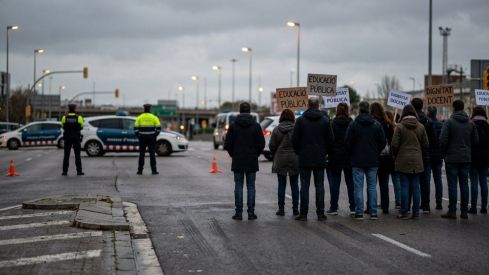
The Mossos d'Esquadra identified or reported 76 teachers between February 11 and March 20. The police actions took place within the framework of the educational strike days called in Catalonia.
The Minister of the Interior, Núria Parlon, confirmed in a parliamentary response addressed to the CUP that the majority of these interventions responded to road blockades organized by teachers. The head of the department assured that no violent incidents were registered in any case during these mobilizations.
The lack of written criteria generates controversy
Parlon revealed that the General Directorate of the Police lacks a specific document that collects the criteria for allowing or denying road closures. This regulatory absence forces officers to be guided by state legislation on the protection of citizen security.
"The Directorate General of the Police has notified that there is no specific document that collects the criteria by which the Generalitat Police - Mossos d'Esquadra (PG-ME) allows or denies the blocking of roads" - Núria Parlon, Minister of the Interior, Generalitat de Catalunya
The current regulations authorize officers to restrict circulation when there are cases of disturbance of public safety. The police can prohibit a blockade if it puts people's integrity at risk.
Only one teacher was sanctioned for serious disorder in the entire autonomous community. The incident occurred in Sant Quirze del Vallès after the closure of the C-58 highway.
Barcelona concentrates half of the performances
The Barcelona police region accumulated 37 identifications or complaints. The protests in the Catalan capital resulted in 10 people reported and 27 identified. Most of the cases were concentrated due to blockades carried out on the ring roads.
The authorities did not identify or report any teachers in the unannounced demonstrations that departed from the institutes towards the central concentration. However, two administrative complaints were filed in the Catalan capital.
One of the reports corresponded to the carrying out of graffiti on February 11. The other was due to the launching of firecrackers against police officers on March 20. That same day, the 11th, the officers drew up a report for the temporary seizure of pyrotechnics from a minor.
In Vilafranca del Penedès, the Mossos identified four teachers on March 17. The teachers were identified as responsible for a sit-in and an unannounced gathering at the Institut Escola Milà i Fontanals. The protesters remained there from the night of March 16 and organized a hot chocolate and a parade at 7:40 AM.
The southern police region did not report any individuals for these events in Vilafranca. Globally, the Metropolitan South Region registered 15 actions, followed by the Metropolitan North and Ponent Regions with 8 each.
Camp de Tarragona added 5 interventions, Terres de l'Ebre 2 and Girona 1. The majority of the police reports were opened for not previously communicating the demonstration or the road closure to the authorities.
The Department of the Interior published a statement confirming the presence of agents from the General Information Police Station at a teachers' assembly in Barcelona. The text justified this action, alleging legal functions of collecting operational information on labor disputes.
ERC, En Comú Podem and the CUP demanded the dismissal of the director general of the police, Josep Lluís Trapero. These groups requested his appearance in the Catalan parliament along with Núria Parlon and the Minister of Education, Esther Niubó. Junts per Catalunya asked for explanations and the appearance of the ministers, but did not comment on Trapero's continuity.