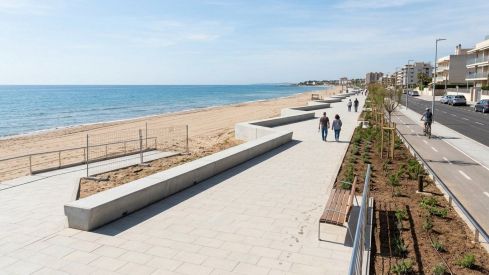
La Pineda has reopened this Monday, April 27, its completely renovated promenade after 14 months of works. The Coasts Service of the Ministry for the Ecological Transition already allows the passage of pedestrians along the new seafront, although some minor gardening works still continue and several fences remain visible in the vicinity of the intervention.
The intervention has involved an investment of 7.2 million euros and affects about one kilometer of promenade, in the section between Hipòlit Lázaro street and the border with Salou. The work, which started in February 2025, had been projected for more than 15 years and has profoundly transformed the coastal facade of this sector of Vila seca.
A new seafront without a road on the front line
One of the most visible changes is the disappearance of the road that ran along the sea. This reorganization has allowed to gain 20 meters of sand width for the beach and redefine the space with criteria of pedestrian use, renaturalization, and stay.
The renovated promenade is articulated in three sections. As a central element, a new zigzag wall has been erected that separates the urban area from the beach and that, at the same time, functions as a grandstand oriented towards the sea. From that structure, an exclusive itinerary for pedestrians and cyclists has been created, with new sidewalks and new urban furniture.
Squares, rest areas and more green space
The layout incorporates irregular shapes and several squares distributed along the route. At these points, areas with seats, hammocks, and parks have been enabled, with the intention of reinforcing the citizen use of the promenade beyond the usual transit next to the beach.
In the strip closest to the interior road of Pau Casals, the green area is maintained, although with a change of concept. The old large grass flowerbeds give way to wooded spaces with native species. The action also reaches the beach itself and the interior lane of the promenade, which preserves circulation and the parking line for vehicles. That interior road has been completely re-asphalted.
Renaturalization of the sandy area
The intervention also foresees new plantings in the sand to generate a dune system. The objective is to recover a more natural aspect of the coastline and favor the retention of sediments in this coastal front of the Tarragonès.
The project is considered one of the largest state investments in the province in recent years and also one of the first examples of de-urbanization of a promenade on the Spanish coast. The reopening for public use comes awaiting an official visit scheduled for this very week, with representatives of the State Government, which will serve to stage the closing of the intervention.