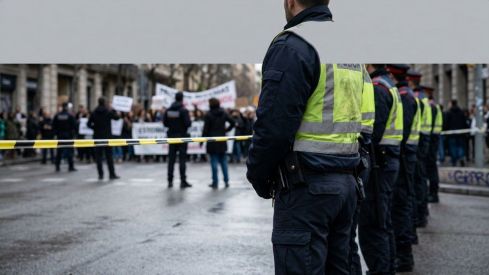
The Department of the Interior has admitted to carrying out multiple police interventions during the teacher strikes held last March. This acknowledgment appears in a report sent to the Parliament of Catalonia in response to a question posed by the CUP regarding the actions of security forces.
The official documentation details that the Mossos d'Esquadra deployed operations in more than twenty Catalan towns. The actions were mainly concentrated in Barcelona but also reached municipalities such as Moià, Tarragona, Montblanc, el Vendrell, Girona, Tordera, Palafolls, Badalona, Granollers, Mataró, Sabadell, Santa Coloma de Gramenet, Molins de Rei, Cornellà de Llobregat, Esplugues de Llobregat, Vilafranca del Penedès, Tàrrega, Lleida, el Pont de Suert and Terres de l'Ebre.
Barcelona concentrates the majority of sanctions and identifications
The Catalan capital registered the most intense police activity according to data provided by the regional executive. The officers identified 27 people during the protest days in the city of Barcelona.
Of that total, ten individuals received administrative complaints. Two of them were processed under the so-called gag law. In addition, the judicial police prepared four informational reports that were sent to the corresponding courts for their evaluation.
The officers also drew up a report for the seizure of pyrotechnic material. In parallel, 16 acts of data collection related to meetings and demonstrations were documented. These figures reflect the volume of control exercised over the participants in the educational mobilizations.
The USTEC union has assessed the content of the report as especially serious. The union training denounces that the Interior Ministry admits the non-existence of a specific document that establishes clear public criteria.
This regulatory absence implies that there are no transparent rules for the Mossos d'Esquadra to allow or deny the blocking of public roads. USTEC describes this situation as absolute opacity on the part of the department led by Joan Ignasi Elena.
The union accuses the Government of violating union rights
The representatives of USTEC underline that many of the police actions were not justified by episodes of violence. On the contrary, the interventions responded to participation in unannounced demonstrations or traffic blockades.
"The most scandalous thing is that many actions are not described by violence, but by unannounced demonstrations, road blockages, route modifications, or identification of people considered organizers, spokespersons, or responsible parties. It is on this last point that everything points to a systematic violation of union rights by the Government, which has placed its repressive focus on the union organization and collective protest" - Spokesperson for USTEC, a teachers' union
The union organization links these events with the recent complaints about police infiltration in faculty assemblies. USTEC states that these are not isolated incidents but a structural pattern.
According to the union, there is political and police persecution directed against the mobilized teaching collective. This dynamic contradicts, in USTEC's opinion, the will for dialogue publicly expressed by the Government.
The unions criticize that Salvador Illa's executive identifies teachers, draws up minutes, and sends judicial proceedings while tolerating intimidation against assemblies. The USTEC leadership summarizes this contradiction with a forceful phrase.
"You cannot negotiate with one hand and watch union members with the other" - Spokesperson for USTEC, a teachers' union
Faced with this situation, the union has demanded immediate explanations from the president of the Generalitat de Catalunya. USTEC demands the immediate cessation of surveillance and infiltration in teacher assemblies.
It also requests the withdrawal of all repressive measures adopted during the strikes. Finally, it demands the reopening of negotiations to resolve the open educational conflict.
USTEC representatives keep their phone lines available this weekend. The wait is due to the possibility that the Government may call an urgent meeting to reopen the negotiation table.