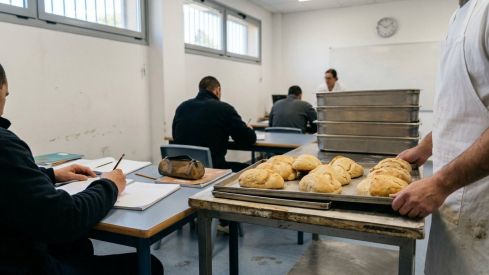
The Pau Casals Adult Education Center operates within the Mas d'Enric prison with an academic structure integrated into the public adult education network of Catalonia. This educational space serves the training needs of the 933 inmates currently serving sentences in the penitentiary facility located in Tarragona.
The prison occupancy rate is 73% and allows for the development of educational programs without saturating the facilities. The center is organically dependent on the Department of Education, although its physical location is restricted to the penitentiary environment inaugurated in 2015.
Compulsory Secondary Education as a gateway to reintegration
A total of 280 inmates lack the Compulsory Secondary Education Graduate title. This figure represents a priority challenge for the teaching team, which seeks to reduce the educational gap before inmates access higher or vocational training.
Christian is 34 years old and began his studies two courses ago. He will obtain his ESO qualification this June after passing the pending subjects with the support of the module's teachers.
"A student is a student, we don't judge them; they are here because they are serving a sentence and we try to provide the most normalized treatment possible." - Center teacher
The faculty is composed of 14 primary school teachers, five secondary school specialists, a school counselor, and an administrator. These professionals manage two teaching shifts, morning and afternoon, to reconcile classes with the jobs that the inmates hold within the prison.
This year, 213 people continue regulated studies at Mas d'Enric. The figure decreases compared to the previous academic year, when 253 inmates enrolled in official subjects, while in the Catalan prison system as a whole, participation reached 1,804 people compared to 2,067 in the previous year.
First bakery promotion in prisons
Vocational training offers different opportunities through the Center for Initiatives for Reintegration. A total of 335 people are enrolled in these courses, highlighting the novelty of the professional certificate in bread and brioche making, which is being taught for the first time in a Catalan prison.
Seventeen students are taking this certificate that combines 360 theoretical hours with 80 practical hours. The essential requirement to access this specialization is to have previously obtained the ESO, which directly links basic academic success with job qualification.
"Around two thousand loaves of bread come out of here every day." - Victoria Aguilar, head of training
The prison's industrial kitchen produces around two thousand loaves of bread daily to supply inmates and workers. This actual production serves as a training ground for students who will become the first graduating class with a degree in this specialty within the prison system.
Other inmates are preparing university entrance exams for those over 25 and 45 years old. In addition, several inmates are studying university degrees in Law, Psychology, Criminology, or Business Administration remotely, as well as Master's degrees in Advocacy, with restricted internet access only for web pages related to their subjects.
The psychological impact of studying
Nuria, the center's director, observes how many inmates arrive convinced they lack intellectual capacity. The teaching work focuses on demonstrating to them that they can improve in areas such as mathematics or history, generating extra motivation especially among the youngest who are illiterate.
Alberto expresses his deep gratitude towards the educational team. His testimony reflects the positive valuation that many participants give to the opportunity to return to books during the fulfillment of their sentence.
"Here, anyone who finishes a study, who graduates, is a triumph." - Professor from the center
Lluís Soria, deputy director of treatment, integrates academic achievements into the individual plan of each inmate. Advancing in studies facilitates progression in prison treatment and allows gradual access to benefits such as release permits, reinforcing the idea that effort leads to tangible results.
Olga, an intern over sixty years old, overcame the initial theoretical requirement and now finds practical meaning in what she has learned. The faculty's satisfaction culminates when they meet former students on the streets of Tarragona who confirm having found employment thanks to the training received behind bars.