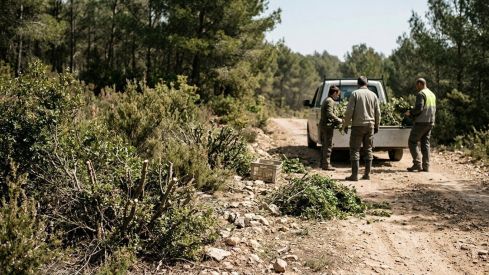
The Generalitat has approved an order that regulates the commercial harvesting of lentisk and heather in Catalan forests and establishes for the first time a system of mandatory prior notification before starting the activity. The new rule determines who can extract these species, under what technical conditions they must do so, and what controls they must comply with after the sale.
The order establishes that only owners of forest land or persons with express authorization may collect. In addition, it will be mandatory to have the permission of the owner of the farm and submit a prior communication to the Generalitat, with a validity of one year.
"Any extractive activity must be notified before starting" - Jaume Minguell, general director of Boscos
Prior control and traceability of the sale
The regulation also incorporates a traceability system to follow the destination of the collected product. Collectors must submit a final declaration with the sales data, including how much they have collected, when they did it, and to whom they sold it. The objective is to provide legal coverage to an activity that until now moved within an ill-defined framework and had generated conflicts on the ground.
"Until now, there was a legal loophole that harmed sustainable management, owners, companies that carry out extraction with traceability, and consumers" - Jaume Minguell, general director of Boscos
The extractive pressure is concentrated especially in Barcelona, Girona and Tarragona, where nearly 75% of the actions related to this activity are accumulated. Among the most affected areas are Camp de Tarragona and Terres de l'Ebre, where harvesting has intensified in recent years, in many cases without permission. The activity also has a significant presence in regions such as Bages and Alt Penedès.
Technical conditions to avoid damage to the forest
The order details how the extraction must be done to reduce the impact on the natural environment. In the case of mastic, it prohibits uprooting the plants and requires cuts that favor regrowth, in addition to respecting maximum extraction limits. For heather, the rule specifies cutting methods aimed at reducing risks in sloped areas and minimizing soil erosion.
The Government maintains that mastic is one of the most commercially collected wild species in Catalonia, followed by heather. The new regulation aims to regulate an activity that had been gaining volume and that, in some aspects, had ended up generating coexistence and safety problems.
"It is an activity that has a social impact in terms of coexistence and generating conflict" - Jaume Minguell, general director of Boscos
On-site surveillance and suspension with high fire risk
The Generalitat's response is not limited to administrative control. The device will also be supported by on-the-ground surveillance and foresees the suspension of harvesting if Plan Alfa reaches high levels. The Government links this measure to the risks detected in recent years, including fires caused by improvised bonfires, conflicts with hunters in hunting zones, and serious accidents.
Among the cited episodes is the case of Tarragona in which a collector died after being accidentally shot by a hunter who mistook him for an animal. Added to this is the detection of alleged organized networks capable of moving tons of lentisk, with logistical structures that include warehouses and international transport. In various operations, overloaded vehicles and people in precarious situations would also have been seized.
A norm with a deterrent and pedagogical intention
The Government frames this order within a strategy of control, but also of prevention. The intention is to introduce a pedagogical component to encourage responsible use of forest resources and curb the idea that mastic is an easy, ownerless resource. With the new regulation, the Generalitat seeks to regulate an activity widespread in several Catalan counties and provide more tools to act against irregular extractions.