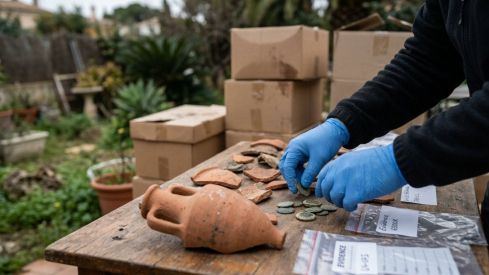
The Guàrdia Urbana has recovered hundreds of archaeological pieces in Tarragona that a retired archaeologist, a resident of Torredembarra, kept outside official circuits, despite having to deliver the material and the excavation report within a legal deadline of two years.
The investigation points to a sustained anomaly for more than three decades. The investigated person's company carried out about 460 excavations since 1991, but in about 260 cases, the material ended up stored in Torredembarra without formal return, while in another 200 cases, the documentation was presented and the pieces were returned.
The investigation began in 2025 after images on social media
The man is now considered a suspect by a local court for alleged crimes of damage to historical heritage and continued misappropriation. The operation was coordinated by the Basic Investigation Unit of the Guàrdia Urbana, the Central Unit for Historical Heritage of the Mossos d'Esquadra, and the Provincial Prosecutor's Office.
Before that final push, there was already a prior alert. In 2021, an archaeologist notified the city council by email that the resident of Torredembarra had in his possession some tiles fallen from the facade of Ca l'Agapito, the old convent of Sant Domènec's Beates.
The key investigation began in December 2025, after the publication of images on social media. From there, agents reconstructed the fate of materials from dozens of archaeological interventions in and outside the city.
"There is no record that the man profited from these pieces, as no evidence has been found that he put them up for sale" - David Font, corporal of the Basic Investigation Unit of the Guàrdia Urbana
Font added that internet searches did not detect any attempts at commercialization. In a similar vein to the reinforcement of the investigation unit, the case required tracing scattered pieces and deposits outside administrative control.
The investigated person handed over 278 boxes and a part will remain outside the municipal circuit
During the operation, the retired archaeologist voluntarily handed over 243 boxes he kept in his house's garden and another 35 in a premises on Civaderia street. The recovered materials will go to the Generalitat de Catalunya, except for a part of a 17th-century tile from Ca l'Agapito.
Among the located pieces are 1,008 copper coins minted in 1811 during the Peninsular War, found on Natzaret street. The agents also recovered a Roman funerary stele made of chamber marble from the imperial period, which was once located in Dames i Vells square.
The inventory also includes a Roman capital from the imperial period of the 4th century AD and numerous boxes with Roman pottery bags. Part of that material, according to the investigation, the man intended to restore it in an unorthodox way.
The recovery has also uncovered pieces outside of any conventional deposit. Two Roman dolia extracted during the excavation of the Jaume I parking lot were given to a neighbor due to lack of space, and the Generalitat de Catalunya will have to collect them directly at that address.
Regarding the Ca l'Agapito tiles, Rubén Viñuales specified that the complete set would consist of a total of 19 tiles. This figure leads one to believe that the missing pieces could be elsewhere.