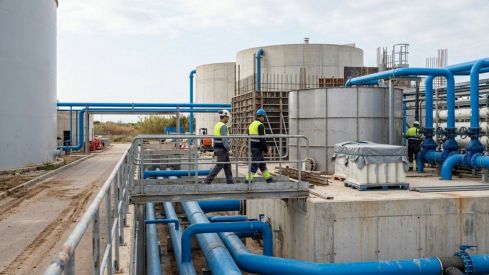
Aitasa has begun the expansion of its regeneration plant for the supply of water to the chemical industry in the southern industrial estate of Tarragona. The intervention seeks to adapt the infrastructure to the growing needs of the industrial sector in an area strategically sensitive to the availability of water resources.
The project will allow increasing the distributed volume from 12 cubic hectometers annually to 15 cubic hectometers in the short term. This expansion represents a 25% increase in the reuse of the available water resource for the factories installed in the petrochemical complex.
A 25% jump in capacity
Daniel Montserrat, director of Aitasa, declares: "Climate change and water scarcity demand rethinking how we use water. Reuse allows us to give this resource a second life and guarantee the continuity of industrial activity without increasing pressure on the environment".
Currently, reclaimed water represents between 18% and 19% of the total supply received by the industrial park. This percentage reflects the current dependence on conventional sources versus the recovery systems implemented to date.
The company promotes recirculation systems to treat water from its own industrial processes. These measures complement the work of the central plant and optimize consumption within each company's facilities.
Innovation to extend the useful life
Aitasa works on the recovery of reverse osmosis membranes to regenerate them and extend their useful life. This technique reduces the need to import new components and decreases the environmental impact associated with the manufacturing of these filtering elements.
A Living Lab project is being promoted that will turn the facilities into an experimentation environment for companies and research centers. The space will serve as a testing ground for new technologies applied to efficient water management.
The objective is to progressively increase the weight of regeneration until reaching a balanced model with conventional capture and recirculation. The final goal consists of reducing the extraction of natural resources through the integration of closed production cycles.