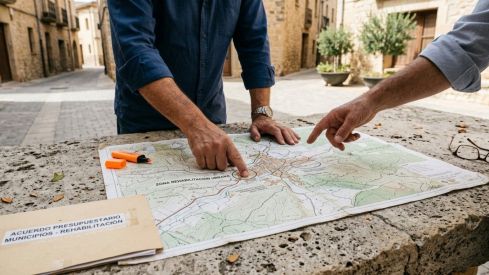
The Generalitat de Catalunya and ERC have reached a budget agreement to deploy the Pla de Pobles 2026 2030, a program endowed with 400 million euros to act in small municipalities and combat depopulation. In the province of Tarragona, 152 municipalities will be able to opt for these investments once the allocation is approved.
The scope of the plan presents an unusual picture in the demarcation. Almost the entire province falls within the criteria set by the Government, as 151 towns in Tarragona have fewer than 5,000 inhabitants and only one regional capital is included through the exceptional route reserved for municipalities of up to 15,000 residents, Móra d'Ebre.
The plan includes 152 municipalities in Tarragona
The call is aimed at town councils with fewer than 5,000 inhabitants, decentralized municipal entities, and also regional capitals with fewer than 15,000 residents. In Tarragona, this combination opens the door to projects in practically the entire rural map of the province.
Falset, with 2,890 inhabitants, and Gandesa, with 3,150, are among the municipalities that will be able to apply through the general route for towns with fewer than 5,000 residents. Móra d'Ebre remains the only case in Tarragona that exceeds this threshold and still enters the program due to its status as a regional capital.
Over the next four years, the program will finance urban, heritage, and residential rehabilitation actions. The design of the plan links with other imbalances detected in the demarcation, such as the lack of housing in Tarragona, although in this case the focus shifts to smaller municipalities.
The funds will be distributed across six axes over four years
The investment will be structured into six areas of action. The plan foresees works in public spaces, recovery of heritage linked to rural tourism, improvement of housing and energy efficiency, adaptation to climate change, revitalization of historic centers, and strengthening the competitiveness of local industrial estates.
This range allows municipalities to combine interventions on old town centers, housing, and economic activity in a single local strategy. It also opens the door to projects of different scales, from urban improvements to actions on heritage facilities or industrial land.
Once the budget item is approved, the provincial councils will be able to start designing and submitting projects to access the funds. The program will maintain this execution framework for four years.
Móra d'Ebre is the only regional capital in Tarragona that exceeds 5,000 inhabitants and does not exceed 15,000, the criterion that allows it to enter the Pla de Pobles along with the 151 smaller municipalities in Tarragona.