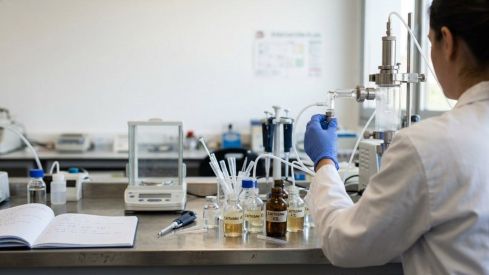
A team from the Universitat Rovira i Virgili is investigating nanocapsules between 200 and 300 nanometers to deliver drugs only to diseased tissue, with potential applications in treatments for cancer or pulmonary hypertension. The group is now working on tests with animal models after obtaining positive results in the laboratory.
The project's main advantage lies in this selective administration. Unlike treatments that also affect healthy tissue, the capsules are designed to recognize the diseased area, adhere to it, and release the active ingredient there, with the aim of using lower doses and reducing side effects.
URV has been developing capsules that target only diseased tissue since 2018
The research began in 2018 and includes Miquel Sistaré, Yaride Pérez, Joan Rosell, and Ricard Garcia. The team describes the capsules as "intelligent and selective" structures due to their physicochemical composition, designed to identify damaged tissue and act upon it.
In addition to this approach, the researchers are considering an alternative strategy with markers incorporated into the capsules. These compounds, they explain, can trick a specific organ into recognizing and absorbing them.
Size is crucial because the capsules measure between 200 and 300 nanometers, a scale the team compares to that of a virus and places below that of a blood cell. This dimension allows them to circulate through the body without being retained in organs such as the liver or pancreas.
In vitro tests yielded positive results, and the project is now scaling up production
Following initial laboratory trials, the group states that the in vitro results were positive and indicate that the technique works and has potential. Based on this, the project has entered the in vivo phase with animal models.
At the same time, the researchers have begun scaling up production to have sufficient material for these studies. The nanocapsules are manufactured with biopolymers compatible with medical use.
The particles are obtained through atomization. In this process, a liquid solution is nebulized in a controlled environment, forming a cloud of very fine droplets, these droplets dry rapidly, and are then collected in solid particle form.
The technology could reduce doses and open up treatments to more patients
If the line of work advances, the directed administration would allow reducing the amount of medication and shortening the duration of some treatments. The team also proposes a broad decrease in side effects by limiting the drug's action to the diseased area.
That reduction could broaden the profile of patients eligible to receive certain treatments. Among the groups cited by the researchers are children, pregnant women, or people with pathologies that today may be excluded due to the impact of medication on healthy tissue.
Even so, the group frames the development as a long-distance race and places the final formulation of a pharmaceutical product far off. When that phase arrives, administration could be done intravenously, with inhalers, via nebulizers, or in oral tablets.