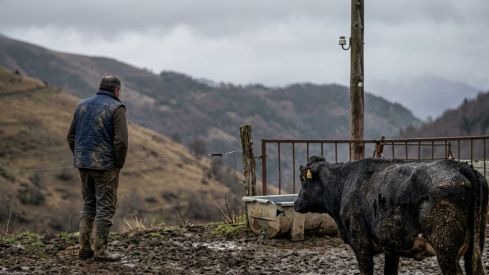
Agricultural organizations and several farmers from Pallars Sobirà have asked the Generalitat to take action on wild boars, deer, and other game species to curb the transmission of tuberculosis to extensive livestock. They demand analyses, vaccinations, and selective culling due to the increase in infections detected this year in Catalonia.
The tension they denounce lies in the different sanitary treatment between livestock and wild fauna. While farms have undergone controls for decades, farmers maintain that equivalent measures are not being applied to wild animals, even though the Generalitat has verified 18 tuberculosis infections in wild boars, with a dozen concentrated in the province of Lleida.
Ten infections in the Pyrenees reactivate sector pressure
Of the 18 confirmed cases in wild boars so far this year, ten correspond to regions in the Pyrenees. This concentration is particularly concerning in areas of extensive livestock farming like Pallars Sobirà, where indirect contact between wild fauna and herds is part of daily life in pastures and water sources.
Xavier Ribera, president of the Federació d'Oví i Cabrum de Catalunya, summarized this complaint by comparing the demands placed on farms with the response regarding wildlife. The leader recalled that herds in Pallars Sobirà have undergone continuous sanitary controls for over 40 years.
"For over 40 years, farms in Pallars Sobirà have undergone sanitary controls for tuberculosis, but while farmers meet all requirements, sufficient measures are not being applied to curb infections from wild fauna" - Xavier Ribera, president, Federació d'Oví i Cabrum de Catalunya
Asaja, the federation, and the farmers who have joined the demand are calling for direct intervention on wild boars, deer, and other game species. Their proposal includes analyses, vaccinations, and culling of infected animals to reduce the risk of transmission to mountain farms.
The sector asks to be declared a tuberculosis-free zone to avoid culling the entire herd
The demand is not limited to wildlife control. The organizations also request that Catalonia cease to be listed as a bovine tuberculosis-free zone, so that an infection on a farm does not necessitate the culling of all animals in the herd.
With that change, the culling would be limited to infected animals. Farmers understand that the current system punishes farms that already comply with health checks and that, moreover, operate in territories where the presence of wild fauna adds a risk factor they do not control.
Francesc Bertran warned of the economic and demographic consequences that, in his opinion, would result from maintaining the current protocols in the mountain regions. In his assessment, the continuity of extensive farming in the Pyrenees is compromised if the health response is not adapted to the reality of the territory.
Lázaro Moreno, an extensive farmer, added another concern by warning that infected wildlife can contaminate water sources in mountain villages. Pere Roqué, president of Asaja Catalunya, called for a specific protection plan for extensive farming and linked this demand to other pressures on farms, such as predation by bears and wolves.
Roqué argued that the review of the system must prioritize those who sustain economic activity in mountain areas. His request to the Generalitat is to modify the sanitary status of Catalonia so that, when a positive case appears, only the infected animals on the affected farm are culled.