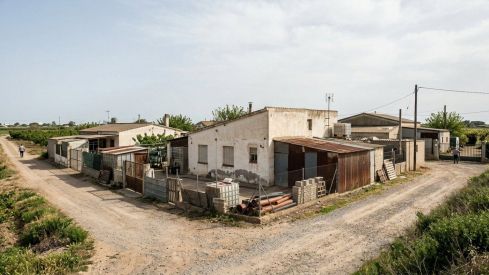
More than half of the 3,100 existing homes in La Horta de Lleida were built illegally after the 1956 law that classified the land as non-developable. This situation generates an administrative block that prevents owners from obtaining licenses for basic renovations.
Market value falls up to 50 percent compared to properties in consolidated areas due to this chronic urban irregularity.
An administrative dead end
The neighbors demand joint solutions from the Generalitat and the Lleida City Council to regularize their legal status. The impossibility of accessing building permits progressively degrades family assets and limits their ability to sell or transfer them.
Francesc Montardit, president of the neighborhood commission, describes the complexity of the conflict between local and regional administrations.
"It's a hot potato for both the neighbors and the City Council, we hope a solution is found soon." - Francesc Montardit, president of the neighborhood commission
The territorial commission has repeatedly urged the council to seek formulas that allow the Generalitat to accept these buildings through the new municipal urban planning plan. Prolonged inaction keeps thousands of families in a situation of permanent legal uncertainty.
Data that debunks antiquity
The latest land use plan for La Horta from 2017 reveals a demographic reality different from the generalized perception about the age of the constructions. Around 1,700 homes currently have registered residents.
Only 840 of these buildings are older than 1956, which shows that the majority emerged after the change in land classification.
The College of Architects of Catalonia confirms that hardly any professional rehabilitation projects arrive because the administration only authorizes works with prior permits. Lluís de la Fuente, president of the Lleida delegation of the organization, warns about the constructive quality of many of these structures.
"Many homes are low-quality self-constructions without architect intervention." - Lluís de la Fuente, president of the Lleida delegation of the College of Architects
De la Fuente considers it inadequate to fill La Horta with new constructions that demand municipal services in areas where the infrastructure cannot be adequately offered. This technical stance clashes head-on with the housing needs of current residents.
The financial burden of irregularity
Real estate agents highlight the direct economic impact on owner families. Josep Maria Esteve, president of the sectoral college in Lleida, explains the difficulties in obtaining conventional bank financing.
Banks limit the mortgage to 50 percent of the appraised value in these cases of proven urban irregularity.
Esteve adds that several homes are listed as warehouses in the official records. This classification implies that, in case of compulsory purchase, the compensation would be calculated according to industrial or agricultural use and not as a habitual residence.
The political path blocked
The Junts parliamentary group attempted to modify the legal framework through allegations to decree-law 2/2025. The proposal sought to empower city councils to regularize scattered dwellings on non-developable land through unitary special plans.
The initiative failed in the corresponding commission at the end of last year. PSC, ERC and Comuns voted against the amendment that intended to address the peri-urban scattered sectors.
The definitive decree-law was published in the Official Gazette of the Generalitat on February 26, 2025, without including the modifications requested by the opposition. The legal situation of the 1,700 registered homes remains unchanged after the political rejection.