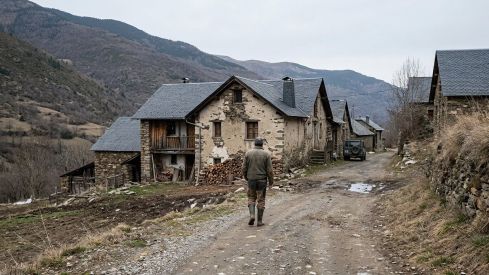
The province of Lleida adds 95 localities with a single inhabitant, according to the figures from the Nomenclátor of the National Institute of Statistics published in January. The data confirms the advance of depopulation in the territory, where in 2008 there were 29 populations in this situation and now they are more than triple.
The highest concentration occurs in the Pyrenees. The three comarcas with the most nuclei or scattered settlements with a single resident are Pallars Jussà, with 27, Pallars Sobirà, with 20, and Alt Urgell, with 19. In the plain comarcas, 23 localities with a single resident are counted, distributed among Segarra with 11, Noguera with 8, Segrià with 1, Urgell with 3, and Solsonès with 1.
The Pyrenees concentrates a good part of the cases
Pallars Jussà is the region with the most villages or hamlets with a single inhabitant. Those 27 enclaves are distributed among the municipalities of Gavet de la Conca, Isona i Conca Dellà, Sant Esteve de la Sarga, Sarroca de Bellera, Senterada, Tremp, La Torre de Cabdella and Castell de Mur.
The evolution of statistics also reflects an increase in empty enclaves. As of January 1, 2026, INE data places at 73 the completely uninhabited villages and aggregated nuclei in the province of Lleida. To that figure are added 156 also empty scattered settlements. In 2008, 38 uninhabited localities were counted.
A changing register and an unequal reality
The statistic starts from the update of the register of population centers and entities carried out by the city councils. That implies that it may not collect uncounted residents or, on the contrary, include residents who no longer live there. The official portrait, therefore, offers a useful demographic reference, although not always accurate in detail in small settlements.
During 2020, the pandemic attracted new residents to rural municipalities of Lleida. Even so, that rebound did not consolidate in many cases. Half of the localities that gained residents with the health emergency lost them two years later, in a sample of the fragility of that movement of return or arrival to the rural world.
Part of the housing stock of the Pyrenees, in addition, is occupied only occasionally because they are second homes. That intermittent use reduces the effective population during a good part of the year and accentuates the difference between built houses and permanently registered residents.
Life in a village of a single neighbor
One of those cases is Àrreu, in the municipality of Alt Àneu. There Eloi Renau lives alone since 2019. He explains that he settled there to carry out his own life plan.
"I bought lands, a house and a borda" - Eloi Renau, neighbor of Àrreu
Renau maintains that this model allows him to continue "without debts" and assures that he does not experience the situation as a total isolation. Although he admits the weight of daily solitude, he also relativizes the distance with services and social life.
"I don't feel isolated" - Eloi Renau, resident of Àrreu
"If it's Sunday and I want to go have a vermouth with a friend, I take the car and go. Esterri d"Àneu is 20 minutes away" - Eloi Renau, resident of Àrreu
His day-to-day, however, has an evident downside. Renau recognizes that "it's getting a bit long for him" going out into the street and not being able to greet anyone. He also focuses on access to the core, a basic issue for the continuity of those who continue to live in these villages.
"It is the umbilical cord that connects Àrreu with the Pyrenees" - Eloi Renau, resident of Àrreu
On the entrance track to the village, he warns that it needs annual maintenance. In a province where both the settlements with a single resident and the completely empty ones grow at the same time, the conservation of accesses and services continues to make the difference between resisting one more year or disappearing from the residential map.