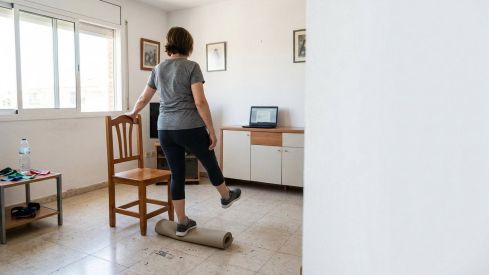
The Biomedical Research Institute of Lleida and the University of Lleida have focused on home telerehabilitation as a possible way to improve the lives of people with hereditary ataxia. The work, developed in the capital of Segrià, suggests that tele-rehabilitation carried out from home and supervised remotely can help this group of patients.
A study driven from Lleida
The research is led by the Health Care Research Group, known as GReCS, and has been developed with the participation of 12 people with hereditary ataxia. The objective has been to analyze the usefulness of a rehabilitation model based on exercises performed at home and remotely controlled.
The proposal starts from a concrete idea, to facilitate access to treatments and provide continuity of care through digital solutions. Within this framework, researchers have evaluated whether this formula can become a useful tool for people with difficulties in maintaining constant in-person rehabilitation.
Positive results, although still provisional
From the institute they point out that the conclusions are not definitive, although the team has been able to extract positive results in this first phase. The study thus points to a possible benefit of home tele-rehabilitation, but without yet closing a complete validation of the model.
The line of work will remain open. The next step will be to expand the sample and conduct longer-term follow-ups to confirm the real utility of this therapeutic strategy and verify its sustained impact over time.
Treatment continuity, at the center
The research places continuity of care as one of the key elements. The underlying premise is that digital solutions can make it easier for patients to maintain their exercises and professional follow-up without leaving home, an option that will now have to be contrasted with more participants and longer observation time.
With this work, the Lleida teams open a new line of analysis on the role that remote care can have in rare neurological pathologies, awaiting future phases of the study to confirm if this tool can be incorporated with guarantees into usual rehabilitation practice.