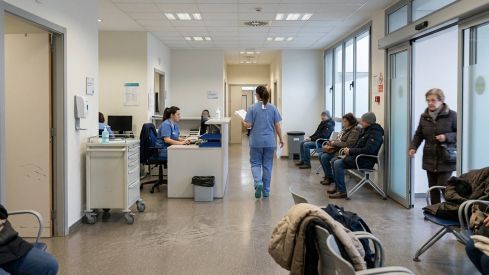
The public health system of the Lleida plain managed 113,678 emergencies between December and February, with a daily average of 1,263 patients attended to in the entire health region. Most of this care pressure was absorbed outside the hospital, in a winter marked by the early onset of flu and the reinforcement of continuous care devices.
The Department of Health made public this Thursday some data that place primary care as the main entry point of the system. 76% of all emergencies were resolved at this care level, with 86,352 cases channeled between primary care centers, CUAP, and continuous care points.
Primary care assumed three out of every four emergencies
Within this volume, the CUAP of Lleida attended to 25,412 emergencies during the three winter months, while the CUAP of Mollerussa registered 14,945. To this are added the 45,995 emergencies resolved by the continuous care points of the region.
The figures remain at levels similar to those of the previous year, with the exception of the Mollerussa CUAP, which this winter was already operating at full capacity. Its full implementation improved territorial accessibility and reduced travel towards Lleida.
"We have designed an action plan to involve the entire region, not only the emergency services, to face the healthcare pressure of these months in an agile and coordinated way" - Rosa Maria Pérez, manager of the Lleida Health Region
During the months of highest demand, the nursing staff was expanded in the two CUAPs. Pediatric care was also reinforced in the CUAP Lleida during weekends and holidays to absorb part of the increase in consultations.
The Arnau de Vilanova registered more than 27,000 emergencies
At the Arnau de Vilanova University Hospital, 27,326 emergencies were recorded between December and February. Of the total number of patients treated at the hospital, 15.5% ended up requiring admission.
To cope with activity peaks, short-stay units were activated both at Arnau de Vilanova and at Santa Maria University Hospital, intended for patients under observation without admission to a conventional ward. In the weeks with more pressure, a team of professionals was also incorporated into the Emergency Department to streamline the initial assessment between triage and admission.
Home hospitalization doubled its activity thanks to the reinforcement of human and material resources. At the same time, the inverse referral system between Arnau de Vilanova and CUAP Lleida allowed redirecting mild cases from the hospital towards primary care.
"This winter we have noticed the impact of the home self-selection tool that has reduced low-complexity emergencies at the Hospital. Likewise, we have detected an increase in the complexity we have attended to in Emergencies and we have improved patient flows between us and the CUAP Lleida" - Oriol Yuguero, territorial clinical director of Emergencies
More resources in home care and weekly coordination
Intermediate care implemented an automated system for admission and discharge information to facilitate daily monitoring of social and health resources. In parallel, the ADIC intensified support for primary care to guarantee continuity of home care for fragile patients during weekends and holidays.
The Medical Emergency System also increased resources in the time slots of greatest activity. For its part, 061 Salut Respon managed 14,723 queries and referred each case to the most appropriate resource depending on the care need.
The coordination of all devices was articulated through the Operational Committee for Urgencies and Emergencies of the health region, which held weekly meetings of the technical commission to adjust resources and circuits.
"The objective is that each person is attended to in the most appropriate resource according to their need, and this winter's data demonstrate that primary care is key to ordering demand and making the entire healthcare system more efficient" - Pilar Vaqué, manager of Primary Care and in the Community in Lleida
The flu came early and reached its peak in December
Influenza was the predominant respiratory virus in the Lleida health region. Activity started earlier than in previous seasons and peaked in mid-December, with an incidence of 564 cases per 100,000 inhabitants. This behavior conditioned a good part of the winter's healthcare demand and forced the maintenance of reinforcements in primary care, hospital emergencies, and home care to avoid further overloading the system.