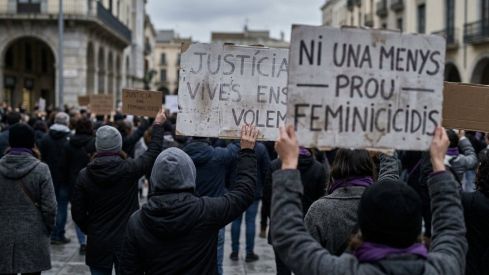
More than a hundred people gathered this Tuesday in Josep Tarradellas square in Figueres to denounce the murder of Kimberli D.G., which occurred a week ago, and to demand a more effective response to gender-based violence.
The protest focused on a gap that runs through the entire case. The participants denounced that complaints, protection orders, and protocols exist, but they do not guarantee real safety when violence advances before protection.
Spokespersons denounced that protection arrived too late
Feminist collectives, social entities, and activists from l'Alt Empordà promoted the call. At the beginning of the reading of the manifesto, the spokespersons rejected any attempt to downplay the crime with other expressions.
"This has a name: gender-based violence. And we will not downplay it, we will not sugarcoat it, nor will we hide it behind soft words" - Spokespersons of the gathering, reading of the manifesto, Figueres
During the event, the organizers criticized the slowness of the protection system. They also maintained that a complaint cannot be reduced to a mere formality and that a protection order cannot remain on paper without real effects.
Les Emporderades, a collective formed by women from l'Alt Empordà who have overcome gender-based violence, placed the crime within a structure of control and violence against women. In the manifesto, the group stated that a man believed he had a right over the victim's life, stalked her, ignored her boundaries, and ended up killing her.
Furthermore, the speakers rejected institutional responses limited to public gestures. In their reading, they emphasized that condemning and regretting the events is not equivalent to protecting a woman when she asks for help or expresses fear.
The manifesto defended Kimberli as a trans woman and rejected the dissemination of images
Another focus of the gathering was the explicit defense of Kimberli D.G.'s identity. The text responded to discourses that questioned whether the case should be treated as gender-based violence because she was a trans woman.
The spokespersons argued that no prejudice or debate about her identity can alter that framework. They also demanded that when a woman says she is afraid, no one should ask her to wait, endure, or further demonstrate the danger.
The manifesto also railed against the dissemination of images of the victim agonizing on social media. The organizers reproached that there were people who recorded the scene before providing aid and rejected turning the aggression into a viral spectacle.
Two friends of Kimberli D.G. took the floor to ask that the case not disappear from public conversation in a few days. In tears, they demanded that visibility be maintained not only for her, but also for all women who suffer violence.
The rally ended without a minute of silence. Instead, the square responded with a collective shout and a date turned into a memory, because the victim's friends recalled that Kimberli would have turned 33 on May 30.