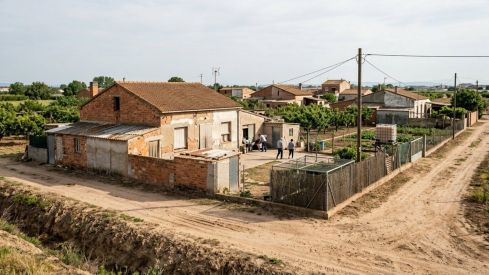
More than half of the 3,100 scattered homes in the districts of Horta de Lérida lack a license because they were built after 1956, the year in which the regulations declared the land non-developable.
The last usage plan approved in 2017 certifies that only 840 constructions are prior to that legal deadline. This situation has generated a legal limbo that paralyzes the real estate market and blocks any attempt at structural improvement in the affected homes.
Bank financing is halved
Financial entities apply restrictive criteria when valuing these irregular properties. Banks only finance up to 50% of the value in mortgages requested to acquire these properties, which forces buyers to have large amounts of prior savings.
Josep Maria Esteve, president of the college of API of Lleida, confirms this difficulty of access to credit. The lack of legal certainty about the property causes the sale price to plummet compared to a consolidated development.
"It's a hot potato for both the neighbors and the City Council, we hope a solution is found soon." - Francesc Montardit, president of the neighborhood commission
Administrative uncertainty also halts maintenance work. Owners cannot obtain permits for rehabilitations or comprehensive renovations, which accelerates the deterioration of the existing real estate stock.
Technical and architectural blocking
Lluís de la Fuente, president of the Lleida delegation of the College of Architects of Catalonia, warns about the absence of professional projects in the area. The impossibility of legalizing actions discourages qualified technical intervention.
"We hardly get any rehabilitation projects in L'Horta because they can only be undertaken if they have a license." - Lluís de la Fuente, president of the Lleida delegation of the College of Architects of Catalonia
De la Fuente adds that many of the homes are low-quality self-constructions in which an architect has never intervened. This constructive reality further complicates any future regularization strategy.
Some buildings are registered as agricultural warehouses. This classification distorts their real valuation in case of expropriation and distances the possibility of recognizing them as habitual residences.
Failure of the parliamentary route
The Junts parliamentary group tried to modify the legal framework through allegations to decree-law 2/2025 on urgent measures in housing and urban planning. The proposal sought to allow the singular regulation of peri-urban sectors bordering the urban fabric.
The commission rejected the amendment at the end of last year with votes against from PSC, ERC, and Comuns. The final text was published in the Official Gazette of the Government of Catalonia on February 26, 2025, without including the requested modifications.
Approximately 1,700 homes have registered residents according to the 2017 document. The residents continue to demand solutions from the Lérida City Council and the Government of Catalonia while the legal status of their homes remains undefined.