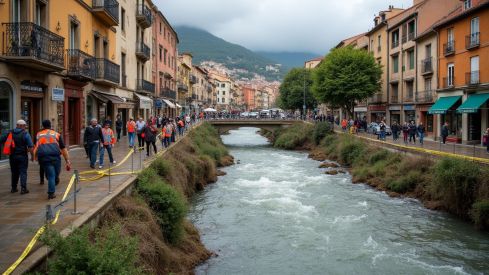
Municipal brigades in Girona continued their work on Wednesday morning to restore normalcy in the areas most affected by the strong easterly wind and heavy rains recorded on Tuesday. The city experienced a difficult day, with incidents in public spaces and restrictions in several areas near the Onyar River.
Tree Removal and Business Reopening
Rainfall forced the removal of 26 fallen trees in different parts of the city. Shops located next to the Onyar River, which were forced to close as a precaution on Tuesday, have been able to reopen normally. From early morning, access to municipal parks and gardens remained closed as a preventive measure.
Prevention Measures in Neighborhoods and Ravines
The City Council marked several flood-risk areas in Campdorà, Pont Major, Pedret, and Barri Vell. Crossings over streams and torrents, such as the Can Murtra stream in Germans Sàbat and the Can Vilar torrent in Campdorà, were also closed to prevent incidents.
Landslide on Carrer del Carme and emergency works
On Monday night, a landslide occurred on Carrer del Carme, next to the Cementiri Nou. Firefighters and Municipal Police intervened in the area and closed vehicle traffic. Access remains closed to both vehicles and pedestrians as emergency work progresses to stabilize the slope at the end of the street. The work includes the removal of stones, trees, and other unstable elements. Subsequently, the slope will be secured with riprap to prevent further incidents. Traffic is expected to be provisionally restored between Thursday and Friday, although new closures will be scheduled to complete the riprap installation.
A few weeks ago, another landslide had already occurred in this sector during the Christmas rains. The Mas Ramada Neighborhood Association had warned at the time about the inadequacy of the existing protection
Ter and Onyar River Flooding
The Ter and Onyar rivers experienced a notable increase in flow in a few hours. The Ter reached a maximum of 243 cubic meters per second minutes before nine on Tuesday, while the Onyar reached 342 cubic meters per second at twenty past twelve noon, according to data from the gauging stations. This Wednesday morning, the flow of both rivers was around 40 cubic meters per second.
"For the Onyar to overflow, more than 600 cubic meters per second must be reached" - Pau Masramon, president of Aigua és Vida
The municipal government team highlighted on social media that the removal of more than 500 tons of sediment from under the Plaça Catalunya platform last week was key to preventing flooding in the center of Girona.
"The forecast in the preceding days allowed us to minimize the effects of the major flood" - Lluc Salellas, Mayor of Girona
Information and Citizen Services
On Tuesday, the City Council contacted more than 1,700 residents living in the critical zone near the Onyar River and 324 commercial and restaurant establishments in the Carme-Vista Alegre, Barri Vell, and Mercadal neighborhoods. They were informed by phone and in person about the measures to take in case of flooding and the available municipal services. Businesses and restaurants were advised to close as a precautionary measure.
The Palau de Fires was set up to accommodate homeless people throughout the day. A dozen people were transferred to La Sopa or the old UNED to spend the night. In addition, the City Council provided 25 additional beds in these spaces between Monday and Tuesday due to the rainy weather.