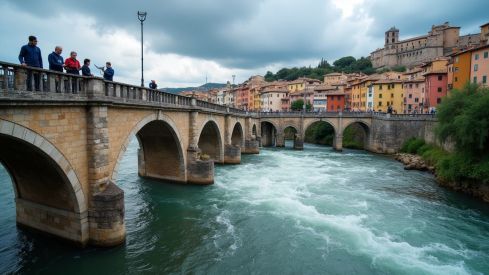
Water management in Girona and the metropolitan area of Barcelona is once again at the center of the debate following the passage of storm "Harry" and the recent actions of the Catalan Water Agency (ACA). The flow of the Onyar River reached 340 cubic meters per second at the Pont de Pedra during January 19 and 20, a figure lower than the 500 cubic meters per second recorded during the "Gloria" storm.
Preventive action at the Susqueda reservoir
The ACA carried out a preventive emptying of the Susqueda reservoir before the arrival of storm "Harry". This measure made it possible to alleviate the flow of the Ter river and avoid more serious floods in Girona, according to industrial engineer and consultant Joan Gaya i Fuertes. The cleaning of the Onyar river, which began on January 16, focused on removing debris accumulated since the "Glòria" storm.
"The great action has been that of the ACA, preemptively emptying Susqueda to relieve the Ter while the Onyar was growing" - Joan Gaya, industrial engineer
The distribution of water and the fulfillment of the Ter agreement
Joan Gaya underlines that in Catalonia there is enough water, although its distribution and management can be improved. The historic Ter agreement, signed in 2017, establishes that by 2028 at the latest 30% of the river's flow will be allocated to the metropolitan area of Barcelona. Gaya confirms that this limit is being met and that there is constant monitoring by users of Baix Ter.
From the end of 1967 to 2025, the Ter will have contributed 11,000 cubic hectometers of water to Barcelona and its surroundings. In July 2023, the Susqueda reservoir was at 28.8% of its capacity, while on the 4th of that month the joint reserves of Sau and Susqueda reached 94%.
"Yes, yes, it is being fulfilled and, furthermore, this is closely monitored by all water users of Baix Ter" - Joan Gaya
Demands for improvement and future planning
The Intercollegiate Observatory of Water of Catalonia, made up of industrial, civil, agricultural engineers and economists, is studying new formulas to optimize water management. The six-year planning period of the ACA is closing its third stage and the fourth cycle, which will cover from 2028 to 2033, is already being prepared. Technical, economic viability and social and political consensus are sought for future measures.
Joan Gaya warns about the age of the Montfullà pipeline in Cardedeu, which has gone six decades without maintenance. He considers a second pipeline necessary to guarantee repairs and maintenance without affecting the supply.
Demand Reduction and Efficient Management
Urban water demand has noticeably decreased since the last drought episodes, especially after the implementation in 2012 of a tiered deterrent fee by the ACA. Gaya insists on the importance of not confusing the lack of rain with poor management of available resources.
"Drought is a word I want to eradicate. Drought is when it doesn't rain, and another thing is that we don't manage the water that has rained or the water that exists in Catalonia well" - Joan Gaya
The Generalitat of Catalonia maintains the powers over the internal basins, where water availability is lower. Currently, the Catalan government has initiated contacts with the Hydrographic Confederation of the Ebro after decades without direct relationship.
In Catalonia there is enough water to cover the needs, although management and distribution continue to be subject to review and debate among experts and administrations.