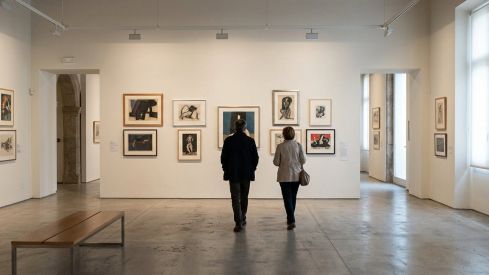
The artistic fund linked to the newspaper Avui, integrated since 2011 into the National Art Collection of the Generalitat, faces a new stage of public dissemination with a project promoted by the Museu d"Art de Girona and El Punt Avui to bring its works closer to the citizens coinciding with the 50th anniversary of the historic masthead. The collection today brings together more than 600 works by nearly 600 authors and keeps its bulk in the Museu d"Art de Girona, while a small part is located in the Museu d"Història Toni Brosa in Barcelona.
The initiative involves documenting the pieces one by one and making them visible both on museuart.cat and in the digital edition of El Punt Avui, based on a connection between both entities activated a few weeks ago. This work has been carried out by the museum's technicians with the advice and expert collaboration of Montse Frisach, who was the art journalist for Avui for years.
A fund born to support the newspaper in 1975
The origin of the collection dates back to August 1975, when Premsa Catalana SA called on all Catalan artists to support the newspaper's project by creating an art fund linked to the future publication. The response was swift. In a few months, nearly 400 works were gathered, which were exhibited in January 1976 at the Fundació Joan Miró under the slogan "A people makes its newspaper".
El Avui finally hit the streets on April 23, 1976, as the first and only daily newspaper published in Catalan since the Republic. Its launch was marked by administrative obstacles from Francoism, although the newspaper managed to be born with broad support from Catalan society and also from the artistic world.
Among the most outstanding contributions was that of Joan Miró, who participated with a lithograph bearing the newspaper's name, valued at 47 million pesetas at the time. Later, the artist became involved again with an original gouache for the 1,000th issue of the publication.
Itinerancy through municipalities and permanent deposit in Vilabertran
The first stage of the fund's establishment was followed by a period of traveling exhibitions. Deposits began with an agreement between Premsa Catalana and the Departament de Cultura of the Generalitat. In 1983, Cultura provided space for the deposited works, and in June of that same year, the first traveling exhibition was inaugurated in Sant Cugat, which later toured fourteen more municipalities.
The second traveling exhibition started in October 1984 in Calella and passed through thirteen more towns before concluding in Ceret. That circulation stopped in October 1991, coinciding with the 5,000 days of the newspaper's publication. Since then, the collection has been permanently deposited in the canonical house of Santa Maria de Vilabertran.
This heritage enclave houses a medieval Romanesque complex with a cloister from the 12th and 13th centuries, a church from the 11th and 12th centuries, and the largest Gothic goldsmithery cross preserved in Catalonia. These elements were declared a cultural asset of national interest in 1930 and are currently part of the Museu d"Història de Catalunya.
Expansion in the nineties and judicial control after the bankruptcy
In 1994, a second stage of growth for the collection was promoted with the invitation to artists to review and update the holdings. As a result of that operation, 158 works were incorporated, which could be seen in September of that year in an exhibition at the Centre de Cultura Contemporània de Barcelona.
The set was valued in 1995 at 279 million pesetas and was revalued in 2005 at 1.4 million euros. In between, in July 2004, Premsa Catalana went bankrupt and the fund came under judicial control, deposited in the monastery of Vilabertran.
The purchase by the Generalitat avoided its dispersal
In 2010 the Generalitat opted to acquire the 604 works from the fund to avoid the disintegration of a collection considered significant and a possible exit from Catalonia. Culture reached agreements with the newspaper's creditors, bought the entirety of the set and divided it into two blocks.
- 24 original cover artworks commissioned over twenty years from various Catalan artists, deposited at the Museu d"Història de Catalunya and already exhibited in 2011
- The other 580 works, deposited at the Museu d"Art de Girona
The space limitations of the Girona museum, located in the Episcopal Palace next to the cathedral of Santa Maria, nevertheless forced the custody of the collection to be maintained in the museum's own facilities in the monastery of Vilabertran.
From Palau Robert to digital dissemination
The new phase of public visibility has already had a first showing in Barcelona. Ten original pieces from the collection were incorporated into the exhibition at the Palau Robert dedicated to the half-century of Avui. Among the works exhibited are pieces by Miró, Tàpies, Ràfols Casamada, Colita, Pilarín Bayés, Brossa, Carme Aguadé, Maria Girona, Tharrats and Català Roca, visible until May 24.
The Girona Art Museum had previously presented two partial exhibitions of the collection. In 2019, it organized "70s 90s. From a certain abstraction to conceptual art", curated by Pilar Parcerisas. In 2023, "Fragments of an instant. The contribution of women artists to the Avui art collection" arrived. Now, the digitization and documentation of all pieces seeks to give continuity to that work and facilitate public access to a collection born from the collective impulse that accompanied the newspaper's birth.