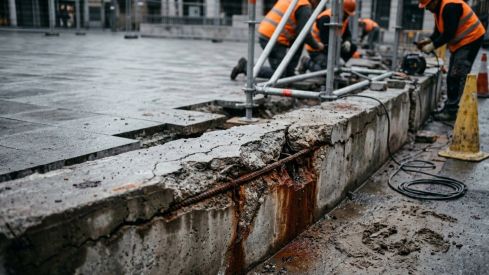
The Girona City Council has initiated emergency works in Plaça de Catalunya to shore up an underground structure with advanced deterioration in one third of its 340 beams. The intervention, awarded to Dapecsa for more than 400,000 euros, seeks to avoid the closure of one of the city's central points.
The tension is that the square will remain open, but with a temporary solution on a base that municipal technicians consider unrecoverable. The storm Harry, recorded on January 19 and 20 with a flow rate of 342 cubic meters per second at the height of Pont de Pedra, accelerated the decision for reasons of structural safety.
Harry precipitated works that seek to avoid the closure of the square
Josep Bayarri, municipal engineer of roads, canals, and ports for the Girona City Council, places the turning point in the inspection after the rainfall episode. The review confirmed that the real condition was worse than expected and required immediate action.
"The structure had its pathologies, but once Harry came and you do the inspection, you see that you have to act. Either I act now or I have to close the square." - Josep Bayarri, municipal engineer of roads, canals, and ports, Girona City Council
The square was built six decades ago, after the floods of October 1962, and the 2021 structural regulations oblige the administration to preserve both the structure and the beams. In the municipal review, damage to concrete and iron was found in about one third of the underground elements.
Bayarri added that the square has an unrecoverable pathology and that the problem goes beyond visible detachments. The technical diagnosis rules out that the reinforcement will resolve the underlying condition of the infrastructure.
The reinforcement will have a maximum useful life of ten years
The municipal government proposes the work as a containment measure. Sergi Font, deputy mayor and councilor for Ecological Transition and Urban Area for Guanyem, compares the reinforcement to a solution that allows time to be gained, but not to repair the damaged base.
"I always use the example that what we are doing is putting crutches on the square. We are not healing the bone of the square, the bone will remain broken. We are putting on crutches that can last five years, ten years, as Josep Bayarri said. We can walk with crutches, but we are not healing the square." - Sergi Font, Deputy Mayor and Councilor for Ecological Transition and Urban Area, Girona City Council
The reinforcement works have an estimated duration of up to ten years. After that horizon, the government team will have to assess whether a comprehensive reform of Plaça de Catalunya, with priority for pedestrians, is viable.
The debate about the infrastructure also intersects with the behavior of the Onyar river in the city center. Anna Ribas, professor of geography and environmental sciences at the University of Girona, already defined the Onyar as an imprisoned urban river and the square as a bottleneck in October 2022.
In parallel, the Girona City Council and the Catalan Water Agency are holding meetings to assess the flood risks in the city, with attention to the Ter-Onyar system and the Ter island in Pedret. A few days before the Harry storm, the council removed sediment from the riverbed, and the government team believes that this action helped reduce the risk during that episode.
The emergency work, awarded to Dapecsa for an amount exceeding 400,000 euros, focuses on reinforcing the damaged beams to keep Plaça de Catalunya open.