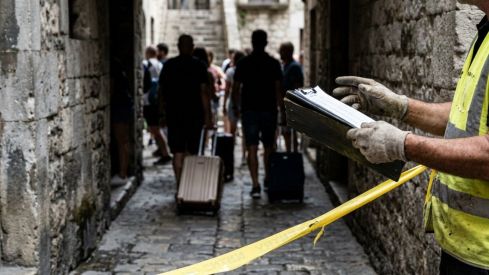
Girona once again throws itself into Temps de Flors for ten days of exhibition in the Barri Vell, with thousands of visitors touring the floral installations and a municipal operation that has closed off the historic area's perimeter to channel access. The city council has set up six entry points, six exit points, and several one-way sections on key streets to avoid crowds.
The increased control coexists with a recurring complaint among residents, shopkeepers, and drivers. While the event fills streets, terraces, and markets and has a strong economic impact, getting around the city center has become more difficult even for those who live there or need to enter for work.
The Barri Vell Forced Changes to Access, Deliveries, and Travel
Laia, a tourism student at the Universitat de Girona, works at one of the checkpoints between Plaça de l'Oli and Carrer Bonaventura Carreras i Peralta. She explains that a large part of her shift consists of directing visitors who ask how to get to a specific point on the route.
"We have to put on a brave face, but many people also understand our work. They mainly ask us how they should get to a specific point" - Laia, tourism student, Universitat de Girona
Not all access points are smooth. The same worker recounts that they have had conflicts with foreign cyclists residing in the area who cross the checkpoint without dismounting, although she adds that most pass on foot, dragging their bikes.
Milos, a resident of the Barri Vell, took an hour to return by car from Sarrià de Ter due to traffic jams. Her case summarizes one of the paradoxes of the operation, as the control designed to manage the massive arrival of visitors also complicates entry for residents.
Deliveries in the Barri Vell can only be made between seven and nine-thirty in the morning. Joan, a salesperson for Massegur, explains that many businesses prefer to advance orders so as not to depend on the arrival of delivery drivers before opening and to protect themselves against the possibility of rain.
Information problems have also surfaced. The exhibition has an adapted itinerary for people with reduced mobility, but teachers from the Maçana school in Salt said they were unaware of its existence and did not receive instructions at the checkpoints, although the staff let them pass upon seeing the wheelchair.
Attendance filled shops and terraces, but increased arrival times
The weekend left a positive balance for a good part of the commercial activity linked to the route. Sara, a jewelry seller at the artisan market of pont de Pedra, assures that last Saturday was a sales success and that the rain arrived when a good part of the public was already leaving.
"Last Saturday was a success and, luckily, it started raining in the afternoon, when we had already made our sales and people were leaving" - Sara, jewelry seller, artisan market of pont de Pedra
A waiter from the Sant Fèlix bar agrees with this assessment and places the weekend among the best moments of the event's start. Monday morning, he adds, also maintained high attendance.
The pull of the event extends beyond the local area. The exhibition has appeared in publications such as National Geographic and attracts visitors from outside Catalonia who arrive in Girona without prior knowledge of the celebration.
Irene and Josep, who came from Barcelona, needed an hour and forty-five minutes to find parking. Both maintain that current attendance is higher than that recorded in the editions after the pandemic.
Among the visitors are also international travelers. Mar, from Vilanova i la Geltrú, accompanied Nail, from France, and April, from Germany, two master's students in London interested in the city's architecture and the filming locations of Game of Thrones, along the route.
Resident complaints coexisted with a protest by teachers on the route
The pressure on mobility has reopened criticism among some residents. Anna, a resident of Girona, maintains that during these days citizens have more difficulty getting around and regrets the accumulated dirt in the city, although she acknowledges that Temps de Flors benefits many businesses.
Discontent also appeared within the itinerary itself. On Carrer Nou, the Joan Puigbert school installed a piece with the inscription We are not here for the flowers, a direct reference to the protests and demands of the teaching staff.
The exhibition will maintain the closed perimeter of the Barri Vell for ten days, with six entrances, six exits, and controls at points such as Plaça de l'Oli and Carrer Bonaventura Carreras i Peralta.