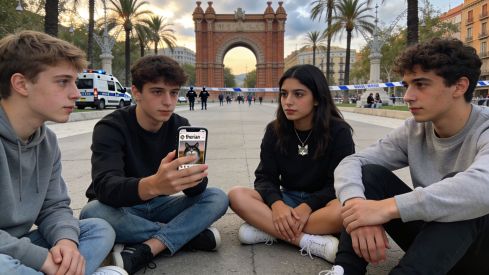
A call for a meeting of people identified as "therian" at the Arc de Triomf in Barcelona last Saturday ended without the presence of the expected participants and with the intervention of the Mossos d'Esquadra, who carried out police charges and arrested one person. The police operation was deployed in the central Barcelona promenade after disturbances were detected in the area.
Police intervention and detention at the Arc de Triomf
The call, previously disseminated on social media, did not materialize as planned. The Mossos d'Esquadra acted after the gathering and made an arrest. No serious injuries were registered, although the tension was evident in the immediate vicinity of the Arc de Triomf, one of the busiest areas of Barcelona's Eixample.
The "therian" phenomenon and its international context
The "therian" movement has followers in countries like the United States and is characterized by subjective identification with animals, in many cases as a form of personal expression. This phenomenon has generated debate in social and psychological spheres, especially due to its visibility in the digital age.
Psychological perspective and keys of the phenomenon
Maria José Valiente, psychologist and collaborator of SanaMente, considers that this type of expressions can surprise or discomfort, but states that the relevant question is what the person who identifies as "therian" is trying to express.
"This phenomenon can surprise, and even make uncomfortable, but perhaps the interesting question is not if it is strange, but what this person is trying to express" - Maria José Valiente, psychologist
Valiente emphasizes that it is an emotional language rather than a literal belief. He adds that when someone claims to feel like a wolf or a cat, they often do not speak of an animal, but of a way of being in the world, of the need to belong, to protect oneself, to feel freedom or to find one's own place.
For her part, Ingrid Mulero, clinical psychologist, places the phenomenon in the context of the digital age and postmodernity, where a crisis of traditional identity values and an identity constructed by the individual themselves is observed. Mulero highlights that this trend is fueled by the idea that biology should not necessarily dictate identity and that there are connections with current debates on gender and neurodivergence.
"This occurs in the digital age and within the framework of postmodernity and individualism, where a significant crisis of traditional identity values stands out, leading to an identity constructed by the individual themselves" - Ingrid Mulero, clinical psychologist
Factors and limits of identity
Maria José Valiente identifies four key factors in this type of phenomena the intense need for belonging, the difficulty in assuming traditional social identities, a high emotional sensitivity and the search for one's own place in the world. Furthermore, she warns that identity has a scope of legitimacy, but cannot be imposed above the biological, legal and functional criteria that sustain collective life.
Both specialists agree that adolescence is a propitious stage for experimentation and the discovery of identity, and that the amplifying effect of social networks plays a relevant role. Valiente concludes that psychology reminds us that the human being has always used symbols to understand himself.
The police intervention at the Arc de Triomf and the arrest made are under investigation. The "therian" phenomenon continues to generate debate in Barcelona and in other cities where similar expressions are observed.