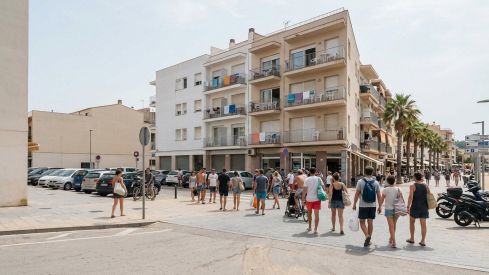
The Baix Empordà, the Alt Empordà and La Selva concentrated in 2024 the highest seasonal population loads of the Girona demarcation, with annual averages of 48,811, 38,340 and 32,254 ETCA people, respectively, according to the latest provisional data from Idescat. In the third quarter, coinciding with the high season, the Baix Empordà reached 122,273 ETCA people, the Alt Empordà 85,742 and La Selva 77,460.
The statistic measures the ETCA seasonal population, which is equivalent to the balance between non-resident entries and resident departures. The calculation is made with an equivalence of 1 out of 365 for each day of presence in a municipality. The statistical institute considers it a measure of the population burdens that each territory bears, by including both those who reside and those who work, study, or spend vacation periods, weekends, or summer stays.
The seasonal pressure concentrates on the Girona coast
The annual data for 2024 once again place the bulk of this floating population in the regions most linked to tourist activity. To the figures for Baix Empordà, Alt Empordà and La Selva are added 10,176 ETCA people in Gironès, 6,434 in Cerdanya and 3,017 in Ripollès.
In contrast, Garrotxa and Pla de l"Estany maintain a negative balance. The first closed 2024 with minus 1,176 ETCA people and the second with minus 826. The evolution compared to 2022 confirms this trend, since Garrotxa went from minus 1,147 to minus 1,176 and Pla de l"Estany from minus 962 to minus 826.
Between 2022 and 2024, furthermore, the main tourist regions continued gaining seasonal weight. The Baix Empordà went from 46,380 to 48,811 ETCA people. The Alt Empordà, from 36,313 to 38,340. La Selva, from 29,407 to 32,254. La Cerdanya, from 5,268 to 6,434. And the Gironès, from 8,052 to 10,176.
El Gironès remains in positive throughout the year
The Gironès was one of the comarcas with a positive balance in the four quarters of 2024. It registered 11,481 ETCA people in the first, 12,340 in the second, 5,904 in the third, and 11,266 in the fourth. That continuity differentiates it from other areas where seasonality skyrockets in summer and falls sharply the rest of the year.
In the capital, Girona city had also maintained a positive sign in the four quarters of 2023, with an annual seasonal population of 12,471 ETCA people. The quarterly breakdown was 12,541 in the first quarter, 14,545 in the second, 8,921 in the third and 14,126 in the fourth.
That behavior fits with a dynamic less linked to sun and beach tourism and more associated with labor, educational, and services mobility. The population advance as of July 1, 2024, already pointed, furthermore, to a demographic growth of the demarcation, which gained 5,366 inhabitants during the first semester of the year.
More than 483,000 regulated tourist places in the demarcation
The Girona demarcation had in 2024 483,183 regulated tourist accommodation places. More than half corresponded to tourist use homes, with 252,356 places. Campsites totaled 132,300 and hotel establishments, 84,367.
By counties, Baix Empordà led the offer with 178,022 tourist places, followed by Alt Empordà with 149,794 and Selva with 107,154. The distribution of this capacity largely explains the strong concentration of seasonal population on the coast and in the main holiday destinations.
Since the 2021 base, Idescat also incorporates an estimate of overnight stays in tourist-use dwellings and of day-trippers for tourist reasons, a methodological adjustment that broadens the real picture of human pressure on municipalities. The agency already warned that, after the changes introduced in 2022 and the new 2021 base, comparisons with previous periods should be made with caution.
Pals and El Port de la Selva, among the most extreme cases
In summer 2023, some municipalities on the Girona coast multiplied their registered population several times over. Pals registered a daily average of 10,718 ETCA people, to which its 2,566 registered inhabitants were added. In El Port de la Selva, the figure was 4,299 ETCA people, in addition to 1,044 residents.
Both municipalities managed to multiply their registered population by five in the third quarter of 2023. Already in 2022, El Port de la Selva topped the Catalan ranking in relation to the registered population, with a seasonal population equivalent to 2,075 people, 204.4% of the resident population. Pals then reached 151.7%.
In that same relationship between seasonal population and residents also stood out Castell Platja d"Aro with 74.0%, Torroella de Montgrí with 65.5%, Llançà with 63.7%, l"Escala with 58.5%, Calonge i Sant Antoni with 56.2%, Castelló d"Empúries with 53.6%, Roses with 43.7% and Lloret de Mar with 43.4%.
Roses and Platja d"Aro, at the head in annual volume
If one looks at the annual total for 2023, the municipalities in Girona with the largest seasonal population were Roses, with 9,575 ETCA people, and Castell d"Aro, Platja d"Aro and s"Agaró, with 9,328. Following them were Torroella de Montgrí with 8,009, Castelló d"Empúries with 6,593, l"Escala with 6,495, Palafrugell with 6,163, Blanes with 5,612 and Palamós with 4,204.
Statistics are not limited to pure tourist volume, although their effect is decisive in a good part of these municipalities. The economic weight of the sector helps to understand this impact. In Catalonia as a whole, tourism moved a business volume of 47,707 million euros in 2023 and employed 451,990 people. That year, the sector's turnover increased by 15.8% and employment by 3.5% annually.
The activity continued to rise afterward. In January 2026, foreign tourism spending with Catalonia as its main destination stood at 1,274 million euros, 14.8% more than a year earlier. Part of that impact also reverts to the territory, since the regulation of the Fund for the Promotion of Tourism reserves 30% of the tourist tax collection for local administrations to finance actions linked to tourism promotion and development.
With this scenario, seasonal population estimates once again place the Costa Brava and its immediate surroundings at the center of Girona's real demographic map, especially in summer, when the effective population of several municipalities shoots up well above the census.