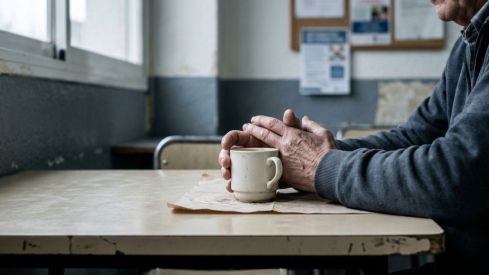
Poverty in the Girona regions not only leaves thousands of families unable to cover basic expenses, but also pushes them into loneliness. 85% of the households attended by Càritas Diocesana de Girona cannot afford to go for a coffee with someone they know, and three out of every four people accompanied by the organization suffer from social isolation.
The contradiction appears in the daily lives of many of these families. Half of the people attended work, but three out of every four do not manage to cover their basic needs, while six out of ten do not have decent housing. In 2025, the organization attended to 23,318 households and reached 46,521 beneficiaries.
Half work, but three out of four do not cover the basics
Caye Gómez, head of Social Analysis for the organization, stated during the presentation of the 2025 Report that poverty breaks personal networks that were already fragile and increases unwanted loneliness. Gómez added that social isolation not only acts as a consequence of exclusion, but also as an element that aggravates it and makes it more lasting.
"When a person does not have an effective support network, difficulties accelerate and it becomes much more difficult to find paths to recovery" - Caye Gómez, head of Social Analysis, Càritas Diocesana de Girona
In addition to isolation, the report records an accumulation of material problems. Two out of every three people attended suffer from the digital divide, and four out of every ten are in an irregular administrative situation. In another of the highlighted figures, six out of every ten people attended do not have decent housing.
Gómez explained that some of the accompanied individuals chain temporary jobs and earn for seven months a year, even though they have expenses for twelve. This instability, combined with rising housing costs, weighs heavily in municipalities like Girona and Celrà and further narrows families' margins.
60% live in rooms, substandard housing, or occupied flats
Housing appears as one of the points of greatest pressure. 60% of the people attended live in substandard housing, rented rooms, or have been forced to occupy a flat, a reality that connects with the housing crisis in cases of greatest vulnerability.
Aixetu Dumbuya, a participant from the entity, stated that access to housing is more complicated for those who suffer exclusion. He recounted that there are people who are rejected because of their skin color or for not being able to provide references, and that this situation ends up pushing families with minor children to occupy a dwelling so as not to be left on the street.
In 2025, Càritas Diocesana de Girona opened the Pis Niu in the Barri Vell of Girona for young people who have recently arrived, are of legal age, are homeless, and are in an irregular administrative situation. The resource is aimed at a profile that appears frequently in the report, marked by residential fragility and the lack of a family network.
Women and families with minors concentrate a good part of the attention
60% of the people attended are women. Another 38% are under 35 years old and the same percentage are in an irregular administrative situation. Among the households accompanied, three out of every four families have minors in their care and 22% are single-parent, mostly headed by women.
Àngels Camós, director of Càritas Diocesana de Girona, pointed out that the entity attends to fewer people than in other periods, but with more accumulated problems. She also assured that, with more economic and human resources, they could reach more cases, although they now adjust the attention to the available means.
"Community is not a fashion, it is what sustains us" - Àngels Camós, director, Càritas Diocesana de Girona
Camós maintained that the community shield formed by family, neighborhood, and close network weakens just when it is most needed. In the same vein, the bishop of Girona, fra Octavi Vilà, placed access to housing and immigration among the main current social challenges and stated that the residential problem prevents many people from leading a free life.
Dumbuya recounted that he arrived at the entity without housing or food after leaving Celrà at the age of 15 to get an education. He also explained that isolation appeared upon leaving his community and that he found support from the first meeting with the organization.
Fra Octavi Vilà framed 2025 as a year of transition due to the appointment of Àngels Camós at the head of the entity, replacing Dolors Puigdevall.