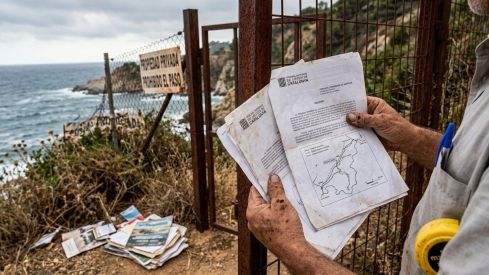
SOS Costa Brava and SOS Lloret have filed objections against the draft urban development agreement that the Lloret de Mar City Council is negotiating with Flinder Data SL to define a new route for the Can Juncadella coastal path, between Cala Morisca and Cala Canyelles. The organizations reject the agreement because they believe it does not ensure the effective opening of a passage that the courts have already recognized as public.
The central objection of the objections lies in the discrepancy between the judicial process and the actual situation on the ground. The affected section has been closed for over 17 years, and a court ruling that, by law, should have been executed within a maximum of two months has been pending forced execution for over three years.
The courts confirmed that the path is public and the closure remains unreversed
The Court of Blanes, the Provincial Court of Girona, and the High Court of Justice of Catalonia have confirmed that this section of Can Juncadella is municipally owned and has historical public use. Despite this series of rulings, the organizations maintain that the new agreement once again postpones the opening of the path.
In their objections, SOS Costa Brava and SOS Lloret describe the text as contrary to law because it does not guarantee the immediate compliance with final judgments. They also warn that the agreement cannot be used to indefinitely postpone the restoration of public use between Cala Morisca and Cala Canyelles.
The organizations add that the draft incorporates new urban planning procedures, special plans, environmental studies, and indeterminate deadlines. In their opinion, this scheme makes the execution of the judgment a longer process instead of resolving a closure that remains active.
The draft cedes part of the control to the property owner and does not set execution dates
Another of the criticisms is directed at the role that the agreement reserves for the property owner. The objections criticize that a significant part of the initiative and control of the process is left in the hands of the same private party that already breached the urban development agreement signed in 2009.
Furthermore, the text does not specify any deadline for the execution of the new coastal path. The document also includes that the Lloret de Mar City Council expressly waives the right to take recovery actions on a part of the current route while the new agreement is being processed.
The discussion about Can Juncadella is integrated into the Camins Lliures campaign, with which the federation monitors the degradation, occupation, or illegal closure of historic paths and coastal paths of the Costa Brava. Within this same framework, it has promoted the sponsorship of sections and coastal areas to document their condition and detect possible irregularities.
SOS Costa Brava argues that the protection of public paths is key to maintaining citizen access to the coast and preserving a collective heritage subjected to urban pressure and privatization processes. The organizations also maintain that the recovery of these paths cannot be conditioned on agreements without a date or new urban negotiations.
The volunteer network has already begun to sponsor sections of coastal paths and coastal areas to record their condition on the ground, and the organizations want to expand it in the coming months.