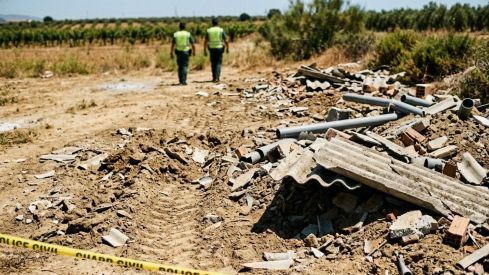
The Cover operation by the Seprona of the Guardia Civil has uncovered in La Axarquía, in the province of Málaga, a network that illegally dumped more than 167,000 tons of construction waste, including asbestos, on agricultural plots. The investigation involves 12 individuals and three legal entities for using a filling and sealing system with which they mixed hazardous waste with inert soils to simulate land leveling.
The case emerges at a time when Spain has an annual average of about 20,000 complaints for illegal dumping and, at the same time, continues to have 195 illegal landfills that have not been closed, sealed, or restored since they were identified in 2008. In early 2024, the European Commission took the State to the EU Court of Justice for these breaches.
The network avoided high costs by mixing asbestos with inert soils
The legal management of one ton of construction waste costs between 15 and 25 euros in the province of Málaga. In the case of hazardous materials such as asbestos, the price increases due to the required safety protocols, a differential that makes fraud a business with a wide margin.
The Guardia Civil maintains that these are not isolated dumps by individuals, but an organized logistical structure. Investigators place the events in the realm of professionalized and specialized crime, with the capacity to hide hazardous waste under an apparent agricultural suitability of the plots.
In addition to the volume dumped, agents estimate the environmental damage caused by the pollution derived from these deposits at more than 6 million euros. The Guardia Civil adds that the alteration of the soil and groundwater leaves a chemical footprint that allows linking the waste to environmental harm.
Spain linked major blows against illegal waste trafficking in one year
Last month, Spain led an international operation against illegal waste trafficking that resulted in 127,000 tons confiscated and 337 arrests. The merchandise came mainly from Italy and France, two countries where legal waste management can cost up to eight times more than in Spain, according to the Guardia Civil.
Last year, another investigation dismantled a gang that deposited 40,000 tons of Italian waste annually in landfills in Tarragona and Conca. That case ended with 15 arrests and a business that had earned 19 million euros since 2021.
Police data show the dimension of the phenomenon. The Seprona registered a total of 17,173 infractions against waste and dumping regulations in 2025, to which were added another 143 for atmospheric pollution.
Pressure on the system also appears in other parts of the southern peninsula. In Almería, more than 400 dumping sites have emerged, mainly of agricultural plastics, after China stopped buying these materials in 2016.
Ecologistes en Acció links fraud to lack of traceability
A spokesperson for Ecologistes en Acció points to the ease with which some operators can move waste out of the legal circuit. The organization denounces that many transporters offer to remove the load for half the price and without the mandatory documentation.
That saving for the waste producer is supported, adds the same spokesperson, by the lack of a more robust control system throughout the load's journey. The absence of strong traceability makes it difficult to track materials that end up in farms, quarries, or illegal dumps.
The business, moreover, fits into an upward trend. Crime linked to waste trafficking is growing at a rate of 5% per year and is already the fourth most important criminal activity in the world.
The European Commission maintained, when taking Spain to the EU Court of Justice, that these 195 illegal dumps pending since 2008 cause serious damage to the environment and pose a risk to human health.