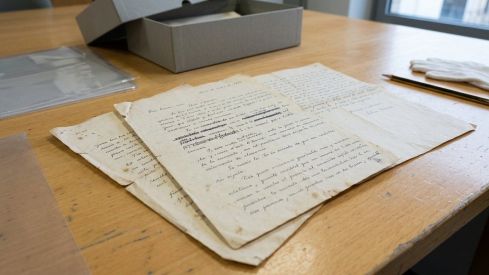
Eighty letters written by Alfons de Batlle i de Molar to his fiancée and later wife, Maria Assumpció Tuèbols i Llauró, during the Civil War have come to light as one of the most relevant epistolary testimonies preserved from the Aragon front and of the combats around Teruel. The correspondence, dated between 1937 and 1938, covers fifteen months of war and directly shows the harshness of life on the front line.
The value of the collection goes beyond the family sphere. The historian and journalist Xavier Martí Ylla places it as the most important known collection of letters written from the Aragon front and, specifically, from the battles around Teruel. Of the eighty preserved missives, seventy were written after Batlle's mobilization.
A testimony from military healthcare
Alfons de Batlle, born in 1916 and deceased in 1997, served as a stretcher-bearer in the Military Health Service. That position allowed him to recount from within the human impact of the war, in a particularly harsh scenario due to the intensity of the fighting and the extreme conditions of winter.
The correspondence covers one of the hardest episodes of the conflict. Between December 1937 and February 1938, the battles of Teruel left 15,000 casualties due to frostbite, with 10,000 on the rebel side and 5,000 on the loyal side. During those weeks, temperatures moved between 18 and 22 degrees below zero.
Extreme cold, scarcity and death on the front
"Many were not wearing adequate clothing, they were barefoot, they slept on the snow, in absolutely subhuman conditions. It is an outrage" - Xavier Martí Ylla, historian and journalist
The letters allow those figures to fit into concrete experiences. Batlle lived the front from a sanitary unit, in direct contact with wounded and dead, in an army marked by material precariousness. Martí Ylla himself summarizes that experience in especially harsh terms.
"He lived through tragic situations, not dramatic, tragic. He escapes from some bombing although he is wounded, he sees many comrades die. They were an impoverished army. How they had to win the war" - Xavier Martí Ylla, historian and journalist
Letters with traces of censorship
The letters also preserve material signs of military control over correspondence. Several pages show erased or crossed-out fragments, a direct trace of the censorship applied in full war to the communications of soldiers with their families.
The collection formed by these letters not only documents the relationship between Alfons de Batlle and Maria Assumpció Tuèbols, but also offers a precise look at the battle of Teruel, the suffering of the combatants and the precariousness of a front subjected to extreme cold, the bombings and the constant vigilance over what could be told in writing.