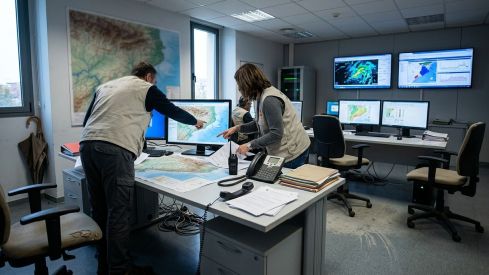
The Generalitat has approved new mechanisms to reinforce the response to floods in Catalonia, with changes in weather forecasting, in emergency protocols and in communication to the population during extreme episodes. The objective is to better anticipate torrential rains and reduce the impact of situations that, according to the Government, are increasingly frequent.
The Minister of Interior, Núria Parlon, defended the need to update procedures given a scenario of greater risk. Parlon maintained that it is urgent to reinforce protocols to reduce the dangers associated with episodes derived from climate change.
A third warning threshold for torrential rains
The main novelty is the incorporation of a third warning threshold for torrential rains within the flood protocol. Until now, there were already indicators for rain intensity in 30 minutes and for accumulation in 24 hours. With the new system, a specific reference is added to detect high-intensity downpours that can leave between 60 and 90 liters in three hours.
The experts consider that this new warning will allow to alert of static episodes that generate exceptional accumulations of an exceptional nature. The forecast is that this threshold helps to anticipate scenarios similar to those registered in recent years in points of southern Catalonia such as Alcanar or Amposta.
Civil Protection points out, however, that this new level does not necessarily translate into an increase in ES Alert messages to the population, since it is an exceptional scenario. Between 2012 and 2020, 54 storm episodes with an intensity of 60 liters in three hours were identified.
Legal advice for confinements or evacuations
The Government has also given the green light to a legal advisory mechanism to endorse the emergency measures that may be adopted in extreme situations. It is a formula similar to the one that was activated during the covid pandemic.
That legal backing is proposed for cases in which it may be necessary to order confinements or evacuations with the aim of protecting the population from torrential rains, floods or flash floods. As a recent precedent, the Govern takes as reference the case of the Cadiz municipality of Grazalema.
656 municipalities with high or very high risk
The update of the risk map raises to 656 the Catalan municipalities with high or very high risk of flooding. The new balance incorporates almost a hundred more compared to previous evaluations and reflects a broader review of the territory, municipality by municipality.
"The new plan has a municipality-by-municipality vision and clearly establishes the risks each one faces in case of torrential rains and floods" - Sílvia Paneque, spokesperson for the Government
Furthermore, in about 290 municipalities, the elaboration of protocols for extreme weather events is expressly recommended. The Generalitat calculates that only half of the city councils currently have an updated and valid flood plan. The other half lacks these mechanisms and must develop them as soon as possible.
The Government reminds that the councils of high-risk localities have the duty to evaluate their situation, execute preventive measures, warn the population, limit access to flood-prone areas and adopt specific measures to protect the most vulnerable groups.
Five major risks and changes in Meteocat's warnings
So far, five types of risks have been identified in the storms affecting Catalan municipalities.
- Fluvial floods
- Maritime floods
- Floods derived from torrential rains
- Floods in mountain areas
- Problems related to the overflowing of reservoirs and the breaking of dams
In parallel, the Generalitat wants to improve the communication of meteorological phenomena that pose a danger. Meteocat will expand its warning system to alert of episodes of torrential rains and other phenomena such as hail, hurricanes or downpours. Technical parameters will also be modified to make the messages more understandable for the citizenry.
One of the changes will be the way of reporting the wind. The warnings will be expressed in kilometers per hour instead of meters per second, with the intention of facilitating their interpretation.
For now, the Govern rules out sanctioning town councils that do not develop plans against floods. The path it is studying is another, providing support to small municipalities that do not have sufficient means to draft them and adapt to a risk scenario that the Catalan administration already considers structural.