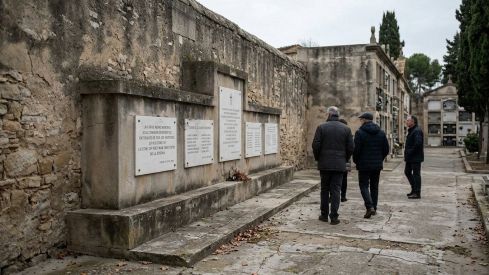
A call has been activated to locate relatives of victims of the Civil War and the Francoist dictatorship buried in the mass grave of Girona's old cemetery. The initiative aims to gather contacts, promote a claim to request an archaeological survey, and clarify the state of the space where, according to municipal documentation, 510 people were shot between March 8, 1939, and January 19, 1945.
The promoters have enabled the email [email protected] to gather information and put families in touch. The search is channeled mainly through the Associació per a la Recuperació de la Memòria Històrica de Llagostera, which keeps a judicial path open to demand the exhumation of victims buried in that same space.
A grave with victims from 153 localities
The registry places the victims in more than 140 towns and extends the list to 153 localities. Of these, 141 correspond to the Girona demarcation and 12 are outside. Among the municipalities with the most victims are Girona with 23, Salt with 22, Olot with 19, Sant Hilari Sacalm with 16, Blanes with 14, and Figueres with 12.
Also appearing are Arbúcies, Llagostera, Palamós, Sant Joan les Fonts and Vilobí d"Onyar, with 10 cases each. In the table of birth population, 13 people born in Sant Hilari Sacalm, 11 in Salt, 10 in Llagostera and 7 in Bescanó are listed.
The municipal documentation places the 510 executions on the south wall of the cemetery. The bulk of the repression is concentrated at the beginning of the post-war period, with 369 executions in 1939 and 468 in the first two years. The day with the most registered executions is July 28, 1939, when 69 people were shot in a single day. Among the victims are two women.
Prospection before proposing an exhumation
"All people included in the registry are identified with first and last names" - René Pacheco
Pacheco maintains that before an exhumation, an archaeological prospection must be carried out to determine the depth of the grave, its limits, the state of preservation of the remains, and the viability of an intervention. On that space, the monument installed in the dignification of 2010 was erected, a circumstance that, in his opinion, may have conditioned the preservation.
If that prospecting confirmed that the action is possible, the approach involves studying an exhumation with archaeological methodology, anthropological analysis and, where appropriate, genetic comparison with relatives. For now, there is no public calendar for a prospecting nor any exhumation order.
A network of relatives and documentation
The call seeks to locate people who can provide oral memory, letters, photographs, documents or DNA, and who want to join a formal claim. At this moment, the initiative is focused on expanding the network of contacts and measuring what real support it can gather.
"The list of people buried in the grave has been consulted by almost 600 people in two weeks" - René Pacheco
In the list of occupations, the peasants form the most numerous group, with 208 cases. The magnitude of the registry and its territorial dispersion explain that the call is directed to families from a good part of the demarcation and also from outside it.
Background of the judicial claim
The grave was dignified in 2010 with the installation of 510 plaques with the name, surname, age, town, and date of execution of each buried victim. That same act also remembered the people who died in the provincial prison of Girona, located in the diocesan seminary, and who were also buried in the grave.
That year the old prison was also marked with a monolith, where there are 45 documented deaths and where in 1940 a prison population of about 3,500 people was estimated.
On the association's website, a lawsuit filed in February 2025 to demand the exhumation of eight residents of Llagostera executed in 1939 appears as an ongoing project. In an informative meeting held in Sant Hilari Sacalm in November 2025, the entity also explained that the lawsuit filed in the Girona courts would affect 14 residents of that municipality buried in the same space.
The first case brought to trial in this new offensive was that of Delfí Sedó, a resident of Bescanó shot on March 30, 1943. In that procedure, the court declared null the court-martial that condemned him and recognized his status as a victim of Francoism, although it refrained from ordering the exhumation, understanding that that decision corresponds to the administration.
The lawyer Montserrat Vinyets has defended in public acts of the association that the open path is that of voluntary jurisdiction to request the exhumation of the bodies, the nullity of the summary proceedings and the recognition of the victims and their relatives. While a material action on the grave is not activated, the movement remains focused on identifying descendants and gathering sufficient support to take the next step in Girona.