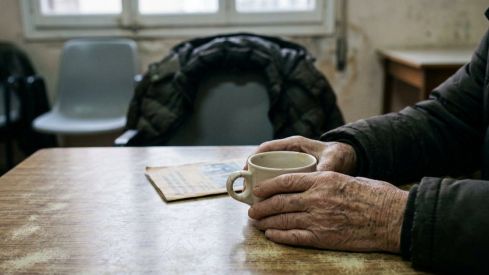
Three out of every four users attended by Càritas Diocesana de Girona during 2025 suffer from social isolation or unwanted loneliness, according to the report presented this Thursday by the entity. The organization also warned that a large part of the people accompanied suffer from housing problems, insufficient income, and the digital divide.
The most striking data appears in the economic profile of those attended. Half of them work, but even so, they cannot make ends meet, a situation that Càritas links to exclusion processes that do not disappear with employment and that worsen when there is no support network.
Càritas attended 46,500 people and half of the users have employment
During the past year, the entity attended 23,318 households and more than 46,500 people in the entire demarcation of Girona. 60% of the users are women and 38% are under 35 years old.
Along with the lack of sufficient income, the report includes other deficiencies that are repeated among the people attended. 60% do not have adequate housing and 66% suffer from the digital divide, while 40% are in an irregular administrative situation.
The combination of these factors appears in different areas of social care that the entity provides in the province. In this framework, the effects of loneliness also fit when they are added to economic precariousness and the lack of stable relationships.
Caye Gómez maintains that lack of support accelerates exclusion
Caye Gómez, head of Social Analysis at Càritas Diocesana de Girona, stressed that isolation acts as a factor that aggravates and chronicizes social exclusion. Her interpretation goes beyond statistical data and identifies the absence of support relationships as an element that hinders any improvement.
"When a person does not have an effective support network, difficulties accelerate and it becomes much more difficult to find paths to recovery." - Caye Gómez, head of Social Analysis, Càritas Diocesana de Girona
The report presented by the organization thus paints a scenario in which employment does not guarantee stability and in which loneliness appears linked to other forms of vulnerability. The entity distributes its activity among a broad territorial network, with a presence in municipalities and local headquarters in the demarcation.
Currently, Càritas Diocesana de Girona has 2,070 volunteers distributed in about fifty local headquarters and carries out 32 social action projects.