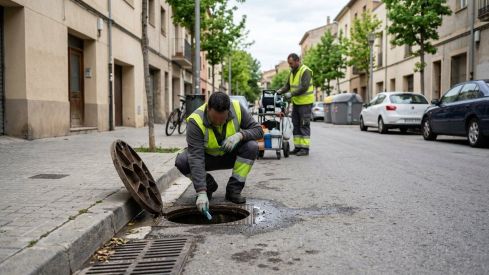
The Girona City Council has put out to tender the tiger mosquito control service in public thoroughfares through larval treatments, with a starting price of 50,405.28 euros. The campaign will focus on the breeding points detected in the city to curb the proliferation of this invasive species and reduce its impact during the months of greatest activity.
Eight neighborhoods with high risk
The action will prioritize eight neighborhoods in Girona with high risk of proliferation in public areas. These are Sant Narcís, Torre de Taialà, Mas Catofa, Germans Sàbat, Domeny, Palau Sacosta, Avellaneda, and Mas Xirgu. In these sectors, a good part of the device foreseen in the municipal contract will be concentrated.
In addition, the plan also contemplates interventions in neighborhoods classified with medium risk such as Santa Eugènia, Can Gibert del Pla, Montjuïc, Montilivi, La Creueta, Font de la Pólvora, Vila Roja and Barri Vell. On the contract map, Torre Gironella appears as the only sector with low risk.
Treatments from May until September
The planned calendar sets an action every eight weeks. The first treatment will be done in May and the following ones will arrive in July and September. The objective is to act before and during the period of greatest presence of the tiger mosquito, which remains active between mid-April and mid-November depending on the meteorology of each season.
The highest concentration of this insect usually occurs between August and October, when rains are more frequent and temperatures remain above ten degrees. The tiger mosquito, native to Asia, finds in these conditions a favorable context for reproduction.
Scuppers and drains as breeding points
The treatments will be applied in the main breeding grounds of public roads, especially in structures where water can accumulate, such as storm drains and drain grates. Last year, more than 1,500 storm drains were controlled and treated in Girona, a figure that shows the dimension of the preventive work in the city.
The municipal brigades also inspect and treat the scuppers located in the interior courtyards of the municipal facilities. Added to this is the installation of specific traps in the centers with higher risk, among them the spaces where summer camps are held.
Prevention to reduce discomfort and health risks
The purpose of the device is to prevent the insect from multiplying, minimize discomfort from bites, and reduce the risk of transmission of tropical diseases such as dengue, chikungunya, and Zika virus. The council insists that prevention is not limited to public spaces and asks for collaboration from residents and businesses.
In this regard, the importance of not leaving containers or other elements that can retain a sufficient sheet of water for mosquito breeding is recalled. Vigilance is also considered especially necessary in public gathering spaces such as orchards, cemeteries, and schools, where this insect can find favorable points to reproduce if water accumulations are not eliminated.