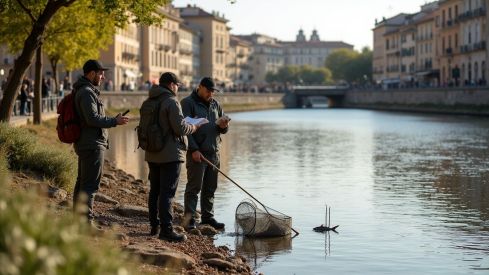
Specialized technicians installed traps on Monday to capture coypus in the Onyar River, near Plaça Catalunya in Girona. The intervention is part of a project to control invasive species promoted by the association La Sorellona, with funding from the Generalitat de Catalunya and the collaboration of the Girona City Council.
Invasive Species Control in the Onyar
The traps set are specific and approved, and will be checked daily to ensure monitoring of the nutria population. Biologist and environmental educator Quim Pou, a member of La Sorellona, highlights the visibility of this animal in the urban environment.
"The coypu has the good fortune or misfortune of being very visible, because it doesn't live underwater" - Quim Pou, La Sorellona
According to Pou, the presence of native species in the Onyar River is very limited. Of every ten or fifteen species, only one is native to the area, and in the case of fish, barely one in a hundred specimens belongs to species native to the area
Environmental Impact and Periodic Monitoring
La Sorellona carries out between three and six annual campaigns in Girona, distributed across up to twenty different points in the municipality. The main objective is not the total eradication of the coypu, but to curb its proliferation and prevent it from spreading to other areas.
"The objective of the actions is not to completely eliminate the species, but to curb its proliferation as much as possible" - Quim Pou, La Sorellona
In the city of Girona, between 100 and 200 coypu are removed each year. The "Ulls al riu!" project allows for continuous monitoring of the state of river ecosystems and periodic intervention on invasive species.
Quim Pou points out that the decrease in native species is mainly related to water quality and the proliferation of invasive species. In the case of Girona, carp are considered even more harmful than coypu.
Difficulties in managing and forecasting expansion
During some campaigns, traps have been stolen, vandalized, or boycotted, which Pou attributes to animal rights groups. La Sorellona maintains its activity to delay the expansion of the coypu as much as possible, especially given the risk of it reaching certain inland ponds, where the population could multiply
The association, created in 2013 by a team of biologists and environmentalists, works in the management of the natural environment and in the preservation of local biodiversity.
- Traps will be checked daily to control the coypu population in the Onyar.
- Between 100 and 200 specimens of this invasive species are removed each year in Girona.
- Only one out of every ten or fifteen species in the river is native, according to La Sorellona.
- The "Ulls al riu!" project allows for continuous monitoring of river ecosystems.