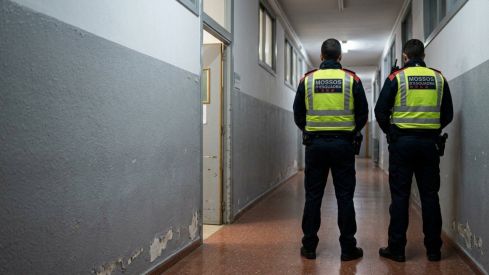
USTEC-STEs and CGT will take to court the presence of two Mossos d'Esquadra agents infiltrated in a teachers' assembly held in a high school in Ciutat Vella. Both organizations have already activated their legal services and place the case in the realm of fundamental rights and union activity.
The tension of the case is concentrated at that point. The unions maintain that a meeting linked to the teaching organization and the debate on strikes ended under police surveillance, and they demand to know who ordered the action, for what purpose, and what information was collected about the participation of the teaching staff.
USTEC-STEs prepares a lawsuit before the TSJC for fundamental rights
USTEC-STEs, integrated into the IAC, is considering filing a lawsuit for violation of fundamental rights before the High Court of Justice of Catalonia. At the same time, it will demand full access from the Department of the Interior to police reports and documentation related to assemblies, strikes, and educational mobilizations.
The union wants to check what data the police collected, for what purpose, and if information related to union participation, attendance at assemblies, or monitoring of teacher strikes was registered.
USTEC-STEs will also take the case to the Catalan Data Protection Authority.
In its public reaction, the organization demands the immediate resignation of the Minister of the Interior, Núria Parlon. USTEC-STEs attributes to the minister the protection of an action that it considers "incompatible with fundamental rights and with respect for trade union activity and assembly spaces".
The CGT asks for explanations from Illa, Parlon and Trapero
For its part, the CGT has announced that its legal services are working to bring to court the infiltration of the two agents in the Ciutat Vella teachers' assembly. The union also extends the demand for political responsibilities beyond the Interior Ministry.
The CGT points to Salvador Illa, Núria Parlon and Josep Lluís Trapero.
The union demands immediate explanations on three specific points. It wants to know who ordered the action, with what political coverage it was carried out, and what the specific objective of the agents' presence at the teachers' meeting was.
Both unions thus place the conflict on two levels. One is the judicial, with the actions that their legal services are preparing before the courts. The other affects the traceability of police action and the possible treatment of data linked to union participation in assemblies, strikes, and educational sector mobilizations.
The most concrete request already made by USTEC-STEs is to access all police reports and documents on assemblies, strikes, and educational mobilizations to verify if there were records of attendance, union activity, or teacher strike follow-up.