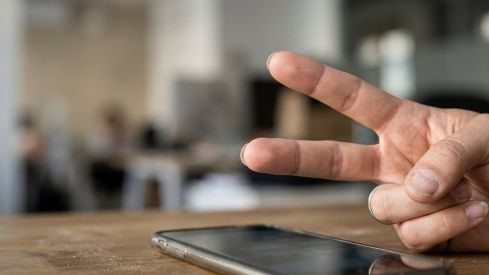
Artificial intelligence can now extract fingerprints from high-resolution photographs when a person poses with the V-sign and shows the lower part of their fingers to the camera. The technical feasibility was exposed in an experiment broadcast on Chinese television and in a public demonstration using a celebrity's selfie.
The paradox is that an everyday image, taken to share on social media or out of simple habit, can contain enough biometric data to attempt to bypass authentication systems. The process does not work on every shot, but it does on many of the most common ones, because most selfies are taken at between 1.5 and 2 meters, a distance that offers sufficient quality to recover ridges with a low margin of error.
The distance of the hand determines how many details AI can recover
Jing Jiwu, a professor at the University of the Chinese Academy of Sciences, stated that the proliferation of high-definition cameras has made it technically possible to reconstruct detailed information of the hand, including fingerprints, from the so-called V-pose.
Lewis Berry, principal security architect and Microsoft MVP at Inforcer, specified that extraction is only viable when the hand is oriented towards the camera and the lower part of the fingers is visible. Without this position, the image loses the necessary information to reconstruct the ridges.
The distance also alters the result. At less than 1.5 meters, detail recovery is high. Between 1.5 and 3 meters, the system obtains approximately half of the information, and above three meters the procedure loses reliability.
A selfie can provide fingerprints from two fingers if the image has sufficient resolution
Li Chang, a cybersecurity expert, publicly demonstrated how to obtain fingerprints from two fingers from a celebrity's selfie using specialized software capable of enhancing the sharpness of the skin ridges. The test reinforced the idea that a capture designed for this purpose is not necessary if the original photo retains sufficient definition.
The experiment broadcast on Chinese television followed a similar logic. It combined editing programs with AI-based enhancement tools to isolate and define the patterns present on the photographed hand.
That material can be used to generate digital replicas intended to deceive biometric authentication systems. Even so, the theft is not completed solely with the image, because the attacker needs physical or remote access to the device on which they want to use that copy.
Berry identified one of the critical points in a widespread habit. Most selfies are taken between 1.5 and 2 meters, a range in which the quality remains sufficient for AI to recover fingerprints with a low margin of error.