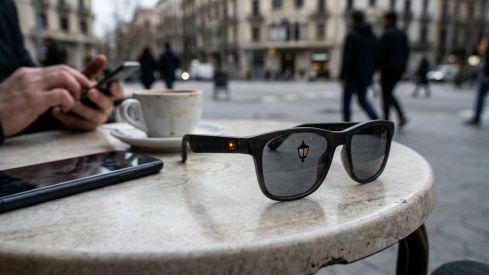
Smart glasses have extended the ability to record and transmit images from everyday spaces, but this convenience also opens up security and privacy risks for the wearer and those nearby. The problem is not limited to capturing video or audio, but extends to passwords, bank details, and private conversations.
The tension arises in the device's very promise. It incorporates an LED light to indicate that it is recording, but this indicator can go unnoticed or be covered, so that third parties can be recorded without their knowledge in hospitals, gyms, schools, changing rooms, or private meetings.
Discreet recording exposes images, voice, and sensitive data
Companies like ESET have warned that the mass adoption of these glasses facilitates the recording of strangers, in a context where countries like Germany and the United Kingdom already have a high density of video surveillance cameras. The leap is not just on the street, but in the possibility of recording sensitive scenes in enclosed spaces.
This is where particularly delicate situations arise. A switched-on camera in a doctor's office, a changing room, or during a private meeting can capture personal information without consent and end up in public dissemination, leading to lawsuits for misuse of image or voice.
Furthermore, the risk does not end with recording. Automatic cloud storage and data transmission to connected services broaden the exposure to leaks, including personal credentials or banking information, as already happens with smart glasses recordings.
A glance is enough to capture passwords, PINs, and bank details
In public spaces, these cameras add another front. So-called shoulder surfing allows passwords, PINs, or bank details to be obtained simply by pointing at screens, keyboards, or payment terminals while someone else is operating normally.
According to ESET, the problem also extends to artificial intelligence platforms connected to the device. Information shared through these tools could become available to other users if the appropriate request is made, a risk that links to the use of data in AI.
Physical access is not even necessary to compromise the device. The glasses can be hacked by exploiting the operating system, compromised applications, public Wi-Fi networks, fake hotspots, or malicious QR codes.
When a malicious actor takes control, the consequences go beyond the loss of files. There can be unauthorized access to accounts, constant surveillance, and even physical effects if the information the user sees on screen is manipulated.
Defenses involve updating the device and limiting connections
To reduce exposure, the recommendation is to keep firmware and applications updated, download add-ons only from trusted sources, and carefully review permissions before installing any new service. It also helps to use multi-factor authentication, robust passwords, secure PINs, or biometric systems.
Away from home, it is advisable to avoid public Wi-Fi networks if a VPN is not used and to disable pairing when the associated mobile phone is not in use. Storing the glasses in their case and regularly deleting unnecessary recordings adds a basic layer of protection.
Among the most sensitive settings is the deactivation of artificial intelligence training and human review, a measure aimed at preventing private recordings from being exposed in the cloud.