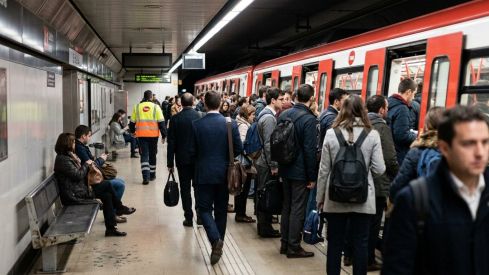
TMB will incorporate one more train on L1 and another on L5 of the Barcelona metro during the morning rush hour starting this Tuesday, with the aim of absorbing the increase in passengers linked to the Rodalies crisis.
The measure will be applied between 7:00 and 9:30 hours. With this reinforcement, the frequency of passage will be 3 minutes on L1 and 2 minutes and 24 seconds on L5, two of the lines with the highest demand in the entire network.
More convoys in circulation in full rush hour
With the incorporation of a new train per line, the operational fleet of L1 will have 35 convoys in circulation during that morning slot, while L5 will have 38 trains.
TMB maintains that this adjustment seeks to respond to the increase in passengers detected in recent weeks. In the case of L1, the increase in ridership stands at 10%, in a context marked by incidents and alterations in Rodalies.
Reinforcement coinciding with the return to classrooms
The president of TMB, Laia Bonet, assured that intense work has been done for these reinforcements to come into operation this Tuesday, coinciding with the resumption of the school year after the Easter break.
"We have worked intensely to activate these reinforcements this Tuesday" - Laia Bonet, president of TMB
L1 and L5 are the most used lines of the Barcelona metro network and, combined, transport more than half of all the subway's annual passenger traffic. The reinforcement is concentrated precisely on these two axes, where demand pressure is being noticed more clearly in the accesses, lobbies, and platforms.
More staff in stations with greater influx
TMB is also deploying other measures in the network, among them a greater presence of staff in the stations with more passengers to order the flows of users and streamline the entrances and exits of the platforms.
In recent days, some users had warned of the risk of falling onto the tracks due to the crowds registered in the subway. With this reinforcement of trains and staff, the operator seeks to alleviate the saturation in the first hours of the day, when a good part of the work and school mobility is concentrated in Barcelona.