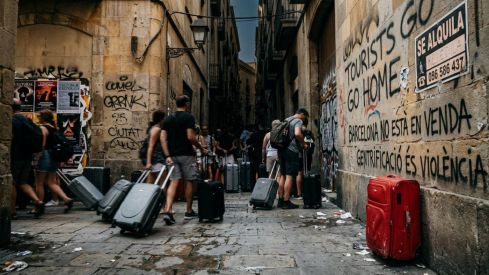
Ciutat Vella endures daily tourist pressure that overwhelms its residential weight. The district adds 2,500,000 tourists who stay overnight per year, an average of 6,850 foreigners daily compared to 115,000 registered residents.
The paradox is that the historic center of Barcelona tries to maintain a stable population while coexisting with a proportion of 22 visitors for every resident. That tension now marks the district's roadmap for housing and for seeking support outside the city.
Ivan Pera seeks a European alliance to claim more funds
The commissioner for the Ciutat Vella Pact, Ivan Pera, maintains that the volume of overnight stays confirms that the district operates on a scale that goes beyond its census. His proposal involves forging an alliance with other European historic centers facing similar problems.
"They demonstrate that the district is much more than its inhabitants" - Ivan Pera, commissioner for the Pact of Ciutat Vella
Pera works with Mar Jiménez, Commissioner for External Affairs, on a common front that aspires to act as a pressure group before the European institutions. The objective is to demand more funds and resources to respond to the tourist overcrowding and the housing crisis in neighborhoods with a similar urban structure.
Amsterdam, Dublín, Marsella and Bilbao are among the cities contemplated.
For now there is no closed agreement with those cities. The initiative remains in the contact phase, although the district sees it as a way to strengthen its capacity for dialogue on a problem it shares with other historic European centers.
District prioritizes 110-year-old apartments and studies converting empty hotels
The other urgency is in the residential park. The last year of the term will focus on accelerating housing rehabilitation in a district where the average age of the apartments reaches 110 years, well above the 65 years of Barcelona as a whole.
In La Rambla, changing the uses of existing buildings is being studied.
The lack of space for new developments leads the district to explore reconversions of properties that have lost their original function. Among the options under consideration is transforming empty theaters and hotels on La Rambla into residential housing.
Alongside this line of action, the district also promotes measures to integrate temporary foreign residents into the local community. The intention is to prevent their relationship with Ciutat Vella from being reduced to consuming the city and to reinforce their bond with neighborhood life.
The housing stock of Ciutat Vella has an average age of 110 years, 45 more than the rest of Barcelona.