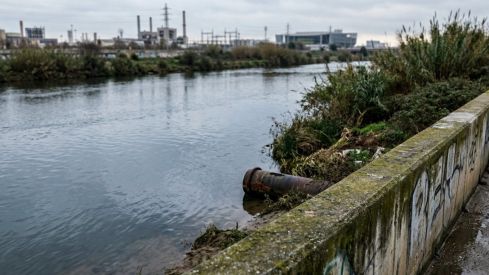
The metropolitan area of Barcelona plans to extend to the Besòs river within a maximum of ten years the water regeneration circuit that already operates in the Llobregat. The objective is to reinforce the supply and reduce dependence on rain in a system that during the last drought already sustained a relevant part of the consumption.
The paradox is that one of the key pieces to guarantee drinking water no longer depends solely on reservoirs and aquifers, but on returning purified water to the river to capture it again later. In the Llobregat, that scheme managed to provide 25% of the metropolitan supply and close to 1,500 liters per second in the most critical moments.
The Llobregat provided 25% of the supply in the last drought
The model that is now intended to be replicated starts from an already operational circuit in Baix Llobregat. The wastewater first passes through the Baix Llobregat Wastewater Treatment Plant (EDAR), then it is regenerated in the Baix Llobregat Regeneration Plant (ERA) and returned to the riverbed twelve kilometers upstream, in Molins de Rei.
From that point, the water travels eight kilometers through the river. During that journey, it completes a natural cleaning process and contributes to recharging the aquifers before the Sant Joan Despí Treatment Plant (ETAP) captures it to make it potable and distribute it in the metropolitan network.
During the last drought, that system allowed a part of the consumption to be decoupled from the direct use of aquifers and reservoirs. In the harshest periods, the circuit managed to provide close to 1,500 liters per second to the supply of the metropolitan area.
The new Besòs ERA will close another circuit with upstream capture
Now the plan is to build an equivalent facility in the Besòs. The future Besòs ERA will be located in the same complex as the Besòs EDAR, in Fòrum, within a project whose technical definition is being finalized after the acceleration of planning initiated in 2023.
The scheme will be similar to that of the Llobregat. A pipeline will return the regenerated water upstream of the river so that the new Besòs ETAP can then capture it, thus completing a recirculation circuit for metropolitan supply.
With the addition of regeneration in the Llobregat and Besòs basins and the production of the Prat de Llobregat desalination plant, Aigües de Barcelona calculates that the system will be able to reach 70% of non-conventional water. This percentage would mark a change in the supply structure during scarcity episodes.
The new Besòs facility is projected in the Fòrum complex and must replicate within a maximum of ten years the circuit that today connects the EDAR and the ERA of Baix Llobregat with the subsequent intake at the ETAP of Sant Joan Despí.