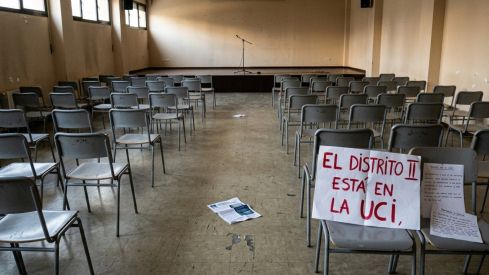
Security and coexistence in Collblanc-La Torrassa were the focus of an extraordinary district council on Thursday, May 21, at the Centre Cultural Collblanc-La Torrassa, which ended amidst neighborhood protests, reproaches to municipal management, and strong criticism of the police and institutional response.
The session revealed a clear contradiction from the outset. While the Mossos d'Esquadra reported a decrease in property crimes, violent robberies, squatting, and crimes against persons in the first five months of the year, a large portion of attendees described a neighborhood living in fear and pointed out that this assessment does not align with their lived experiences on the street, with the shooting two weeks ago at the Josué bar on Rambla Catalana as a backdrop.
Mossos claim several crimes are down and admit limitations with scooters
Sergi González, a sergeant with the Mossos d'Esquadra, stated during the session that between January and May, District II has seen a decrease in property crimes, crimes against persons, violent and intimidating robberies, scooter-related robberies, market and wallet thefts, vehicle thefts, and squatting compared to 2025.
Pablo Villajos, also a sergeant with the Mossos d'Esquadra, added that in five months, they have intervened with more scooters than in the entire previous year. Nevertheless, he specified that the new regulations for these vehicles are not yet fully implemented and that actions against their riders cannot improve until next year.
Villajos also detailed that last year there were 735 incidents with complaints regarding alcohol consumption, noise in public spaces or residences, drugs, and weapons. During the same period, law enforcement agencies conducted 216 inspections of establishments.
Jesús Husillos, deputy mayor of the Area of Security and Internal Government, linked municipal action to police coordination and the Nautilus plan. He explained that this operation has allowed for the imposition of time limitations, precautionary closures, and financial penalties on establishments, and prioritized reducing the number of establishments causing disturbances.
Residents reproached a lack of response and the plenary ended almost empty
Faced with this assessment, attendees expressed disappointment at the absence of an emergency plan and a specific security committee for District II. They also denounced problems with 112, difficulties in filing complaints, and a feeling of lack of protection in Collblanc and La Torrassa.
The platform Stop Degradació Collblanc-La Torrassa attended with signs that read that District II is in the ICU and that the neighborhood has become a dump. Carme Rimbau, a resident and representative of Defensem el Castell de Bellvís, stated that residents feel unprotected.
In the opposition, Coque García, councilor for ERC+EUiA, criticized the lack of response to the requests made by the district's councilors and maintained that what was presented in the room is not perceived on the street due to a lack of resources, personnel, and intensity. Manuel Domínguez, spokesperson for L'Hospitalet en Comú, congratulated entities and residents for having promoted the council and recalled that crime rose by 10% last year in L'Hospitalet de Llobregat while it decreased in almost all of Catalonia.
Sonia Esplugas, spokesperson for the Partit Popular, criticized the official reading of the data and linked resident discontent with an increase in fear. Ester López, councilor for Vox and a resident of the neighborhood for ten years, called for tougher laws, more police presence, and a more accessible police force.
The moment of greatest tension came when a resident from Stop Degradació Collblanc-La Torrassa tried to ask about the creation of an exclusive councilor for District II. The secretariat considered the question to be outside the agenda, and the decision provoked protests in the room, after which the members of the entity left the Centre Cultural Collblanc-La Torrassa, leaving the space practically empty.