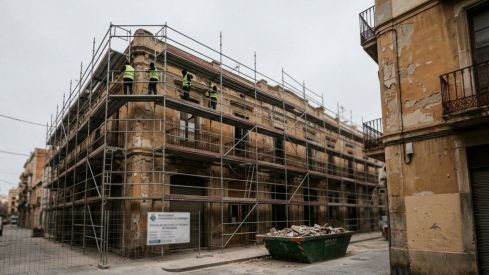
The works to rehabilitate the low houses of the Pons passage, in the La Torrassa neighborhood of L'Hospitalet de Llobregat, have already begun with the aim of converting the complex into social housing managed by the Municipal Housing Service. The action will transform the nine original homes into five adapted apartments for the elderly.
The intervention begins with underlying tension in the project itself. The City Council argues that reducing the number of properties from nine to five allows for increased accessibility and residential quality, while a neighborhood platform maintains that this reduction distorts the original size of a historic complex known as "Murcia chica".
The City Council reduced from nine to five homes to adapt them for the elderly
The original houses, of about 35 square meters each, will become five homes of larger surface area. The project plans to improve ventilation, increase natural light entry, and create new private outdoor spaces.
Laura García Manota, deputy mayor of Ciutat de Drets, frames the reform in the social use that the apartments will have when the works are finished.
"These five homes will be for social use so that, with adaptation, they can be for elderly people. The homes are already being renovated with this vision so that they are fully accessible and adapted spaces so that elderly people in our city can use them" - Laura García Manota, deputy mayor of Ciutat de Drets, L'Hospitalet de Llobregat City Council
The deputy mayor has explained that the change from nine to five homes responds precisely to those criteria of accessibility and residential quality. The council plans to define the social use assignment during the execution of the works through the Housing Office and in coordination with the different municipal services.
The reform will maintain the protected facades of Murcia chica
The project will preserve the typology, the volumetry, and the protected ornamental elements of the facades, although it will reorganize the interiors to adjust them to current regulations and improve habitability. The architectural complex is part of the working-class memory of La Torrassa.
Murcia chica was established in the first half of the 20th century and welcomed workers from southern Spain who participated in the construction of the 1929 International Exposition in Barcelona. The deterioration accumulated over years also affected adjacent buildings.
In 2018, the City Council bought the homes for 300,000 euros after a period of 12 years of illegal occupation. The current action has funding from the Metropolitan Area of Barcelona and adds up to a total investment of 1,249,372.19 euros.
From the platform Defensem el Castell de Bellvís, Carme Rimbau questions whether the operation can be considered a rehabilitation if almost half of the original homes disappear.
"Instead of these 8 or 9 they want to make 5, this is not a rehabilitation, they want to do something else, and if they want to preserve the history, they have to preserve the size they had, otherwise what's the point" - Carme Rimbau, member of the Defensem el Castell de Bellvís platform
The works in the Pons passage will last approximately 12 months.