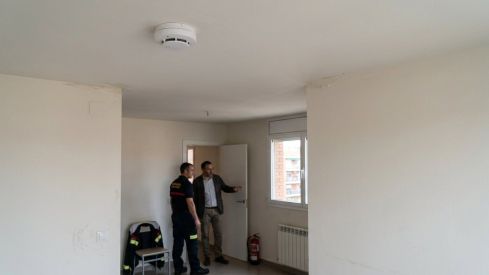
Barcelona will require the installation of smoke detectors in newly built homes starting from 2027 if the schedule foreseen by the City Council is met. The measure will be incorporated into the 2026-2035 Strategic Plan of Barcelona Firefighters and will require the modification of the municipal fire prevention ordinance.
The announcement has been made this Wednesday during the presentation of the new plan, which also contemplates changes in media, staff and infrastructure of the municipal body. The council's forecast is that the new obligation comes into force at the beginning of 2027, once the ordinance is approved.
Detectors in new housing and in 12,000 subsidized flats
In addition to requiring these devices in new construction developments, the City Council plans to install smoke detectors in the city's 12,000 public housing units. For the rest of the population there will not be, for now, a regulatory imposition, but a municipal recommendation to encourage their placement in homes.
"It is an economical device, about 15 or 20 euros, and very easy to put" - Jaume Collboni, mayor of Barcelona
The measure is proposed as a basic prevention tool against fires inside homes. The head of the Civil Protection, Prevention, Fire Extinction and Rescue Service, Sebastià Massagué, defended its usefulness to reduce risks and gain reaction time in critical situations.
"Many people could have saved their lives if they had found out sooner about a fire in their home" - Sebastià Massagué, head of the Civil Protection, Prevention, Fire Extinction and Rescue Service
New emergency center in Poble sec
The plan also foresees the commissioning of the new Barcelona Emergency Operational Coordination Center, the CCOEB. Construction will begin in January 2027 in the Parc de les Tres Xemeneies, in Poble sec, and will replace the current CECOR, located on Lleida street.
The City Council maintains that this new equipment will allow to reinforce the operational integration between the Guàrdia Urbana, the Mossos d'Esquadra, Firefighters and the SEM, with a more direct coordination in the management of incidents and major emergencies within the city.
More staff and new vehicles
Another of the document's main points is the increase in personnel. The operational staff of Bombers de Barcelona will increase from the current 703 to 800 in 2027. The reinforcement comes in a context of increased workload. Massagué warned that days exceeding 100 services are becoming more common.
That increase, according to what was explained during the presentation, is related in part to the effects of climate change, which raise seasonal demand and multiply complex and diverse typology interventions.
The plan also incorporates the renewal and expansion of the vehicle fleet, with the arrival of specialized vehicles for command, resource transport, work at height, and intervention in specific environments. The objective is to adapt the body's response to increasingly technical scenarios.
"Who would have told us a few years ago that we would often find ourselves acting on roofs full of solar panels" - Sebastià Massagué, head of the Civil Protection, Prevention, Fire Extinction and Rescue Service
Massagué cited as a recent example the robot used in a fire in the port of Barcelona, a sample of the progressive incorporation of new tools in interventions with greater difficulty.
Reinforcement of the drone unit
The strategic document also contemplates strengthening the drone unit of Barcelona Firefighters with more devices and new operational capabilities. These teams will serve to improve the initial evaluation of the strategy, follow in real time the evolution of the fire and provide support in forest environments, maritime coast, large structures or difficult-to-access spaces.
With this package of measures, the City Council draws a roadmap for the next decade focused on prevention in homes, the growth of the corps, and the modernization of the response to emergencies in a city where services are increasingly numerous and complex.