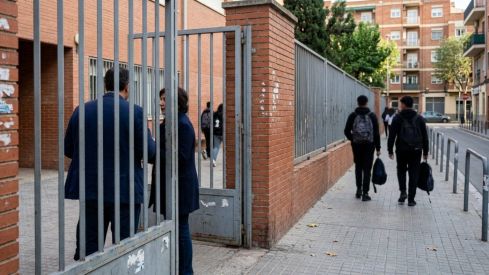
Junts, BComú and ERC have forced an extraordinary commission of Social Rights in the Barcelona City Council to stop the arrival of plainclothes Mossos in high schools. The political objective is clear and urgent. To prevent the pilot test designed by the Department of Education from being applied in the Catalan capital.
No Barcelona center appears on the list selected by the Generalitat for this experiment. Even so, the three groups consider an immediate institutional intervention necessary to shield the city from this measure.
The council must urge the withdrawal of the plan
The parties demand that Jaume Collboni's government speak out against the initiative and pressure the Generalitat to withdraw it. They consider that it is not a specific action but a structural change in the police role within the educational sphere.
"This transforms the centers into surveillance spaces" - Junts, BComú and ERC, joint statement
The warning includes concrete risks for the school community. They warn of a possible deterioration of coexistence and a weakening of the educational relationship between students and teachers. The constant presence of officers could normalize police intervention in everyday conflicts.
International evidence points to the criminalization of minor offenses when there are police in classrooms. This data supports their outright rejection of the model proposed by the regional executive.
Union rejection and flight of centers
The educational unions have also strongly criticized the pilot plan. They maintain that having police in schools will not contribute anything positive to the daily management of institutes. They demand more pedagogical resources instead of security devices.
Four centers have already requested to leave the program due to pressure from the environment. Among them, the Margarida Xirgu Institute in L'Hospitalet de Llobregat stands out. The teachers of this institute have already demonstrated to show their discontent.
The teachers of Margarida Xirgu have mobilized against the initiative in an early display of organized resistance. Their action reflects the tension the measure is generating in the faculty.
A social prevention-based alternative
Faced with the police presence, the proponent groups defend an alternative model focused on prevention. They propose increasing the number of social educators, psychologists, and counselors in all educational centers in the city.
The proposal includes increasing the number of security guards during lunchtime and extracurricular activities. They also propose strengthening social intervention teams to address the underlying inequalities affecting students.
The debate transcends security to enter the realm of educational philosophy. The extraordinary commission will serve to define whether Barcelona accepts or rejects this new paradigm of school coexistence imposed from outside.